


A home inspector’s understanding of Pushmatic panels in Kansas City, MO homes, with safety warnings and panel replacement costs
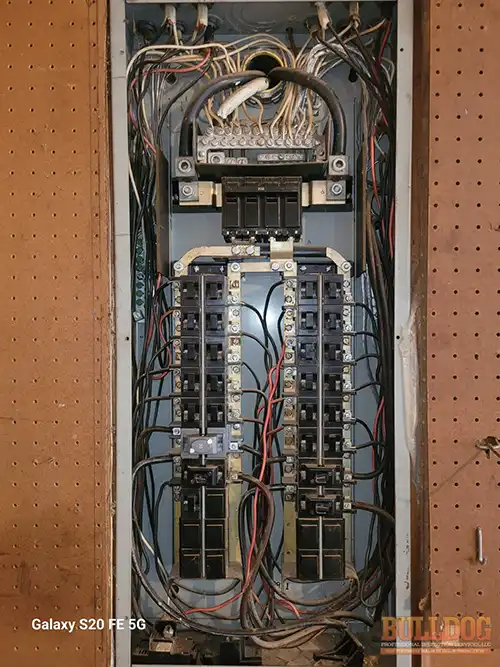
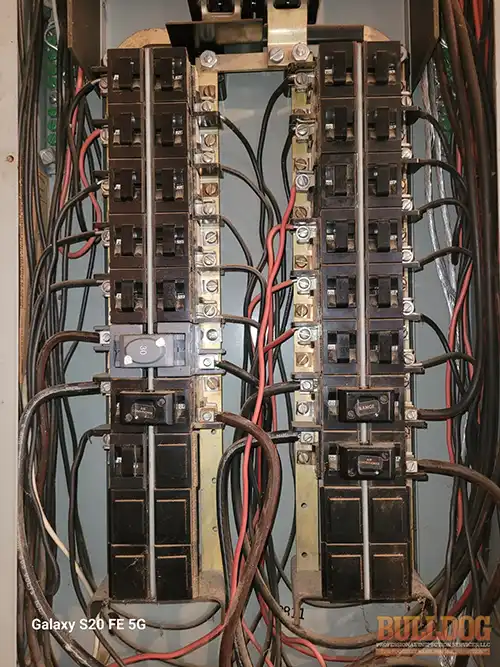
Last Wednesday morning during the electrical inspection of a vacant 53-year-old reverse 1.5-story home in the Coves subdivision of Kansas City, MO, I found a Pushmatic panel.
Pushmatic panels were never officially recalled, but they’re considered outdated and potentially hazardous due to stiff, unreliable breakers that can fail to trip or reset.
Most electricians in Kansas City, MO recommend panel replacement.
There were no obvious problems with the panel enclosure, breakers, or wiring inside the panel, but the home was also wired with aluminum wiring before the integration of AL/CU breakers, switches, and outlets that solved the aluminum wiring expansion issue. As a result, the housing to one of the living room light switches was scalding hot to the touch.
This hinted at a dangerous underlying electrical condition in the Kansas City, MO home, likely tied to the electrical wiring.
Pushmatic panels don’t just age poorly—they fail in ways that create real safety risks.
The breakers in these panels get stiff and unreliable over time.
When a breaker can’t trip properly during an overload, it allows excessive current to flow through wiring. This creates fire risk through overheating. The indicator problem adds another layer of danger—a breaker might show “off” while staying electrically live, which means serious shock risk for anyone working on what they think is a dead circuit.
Most Pushmatic panels in Kansas City, MO are 40-70 years old now.
The original designs from the 1950s and 1960s used only thermal trip mechanisms without the magnetic trip feature you’ll find in modern breakers. They respond slower to short circuits compared to current equipment, though their overload response stays adequate.
Replacement parts have gotten scarce and expensive since manufacturing stopped decades ago. When breakers fail, you often can’t find compatible replacements, leaving circuits dead. Many insurance companies in Kansas City, MO see Pushmatic panels as a risk and either charge higher premiums or require panel replacement before they’ll issue coverage.
Thing is, these panels worked reliably for their first 20-30 years. The problems show up as internal components age past their design life.
Understanding Pushmatic Panels: What They Are and Why They Fail
A Pushmatic panel is a residential circuit breaker panel manufactured primarily in the 1950s through 1970s by Bulldog Electric, later acquired by ITE and eventually Siemens, featuring distinctive push-button style breakers instead of toggle switches and known for heavy-duty bolt-on construction but also for reliability problems as the panels age beyond 40-50 years.
What Is a Pushmatic Panel?
The panels got their name from how the breakers work.
Instead of flipping a toggle switch up or down like modern breakers, you push the button in to turn circuits on and pull it out to turn them off.
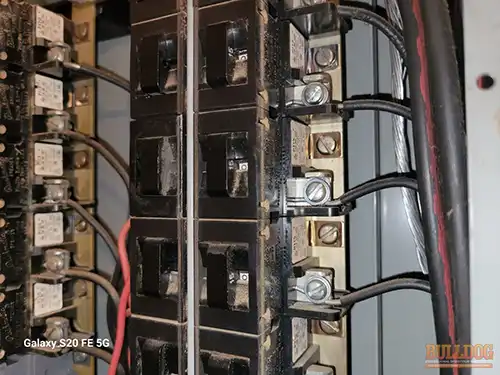
The breakers bolt directly onto the bus bars inside the panel. This creates a more secure connection than the clip-on style breakers in many other panels from that era. This bolt-on design was actually one of the panel’s selling points when they were new.
You’ll recognize a Pushmatic panel by those distinct round push buttons arranged in rows.
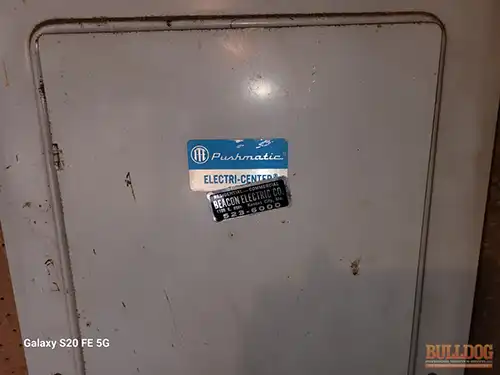
Most panels in Kansas City, MO have tan or gray metal enclosures with the manufacturer name stamped on the door.
Why Pushmatic Breakers Become Unreliable
The breakers use grease-lubricated internal mechanisms that dry out over decades.
When breakers sit idle without regular exercise, the lubricating grease separates. The oil evaporates or drips away, leaving behind a soap-like carrier that absorbs moisture and promotes rust.
As rust forms between moving and stationary parts, the mechanism requires increasing force to operate until it eventually jams.
The spring mechanisms inside also weaken, corrode, and break as panels age past their design life. Most Pushmatic panels in Kansas City, MO are 40-70 years old now, which means the grease has been breaking down for decades.
The breakers weren’t designed to last this long without maintenance that almost no homeowner in Kansas City, MO ever performs.
How Panel Replacement Becomes Necessary
The stiffness problem gets worse gradually.
You’ll first notice a breaker resists being pushed in or feels like it takes excessive force to reset.
Some breakers appear stuck in one position or won’t click positively into place. The most dangerous failure mode happens when the internal mechanism jams so the breaker shows “off” externally while remaining electrically energized inside. This creates serious shock risk for anyone assuming the circuit’s dead.
Eventually, breakers fail completely and won’t reset at all, leaving circuits inoperable and making panel replacement necessary.
That’s when you’ll discover compatible replacement breakers cost $40-60 each compared to $8-15 for modern breakers, assuming you can find the right model for your specific panel vintage.
Let’s address the most common questions about Pushmatic panels I encounter during inspections in Kansas City, MO.
Are Pushmatic electrical panels safe?
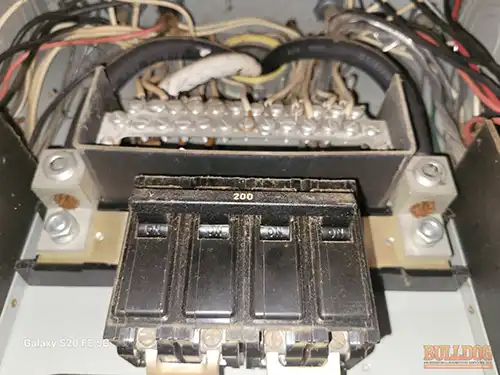
Pushmatic panels aren’t considered highly dangerous like Federal Pacific panels, but they have reliability issues that make most electricians in Kansas City, MO recommend panel replacement rather than long-term use.
The main safety concern stems from breakers that become stiff over time and may fail to trip during electrical overloads. When a breaker doesn’t trip properly, it allows excessive current to flow through wiring, creating fire risk through overheating in Kansas City, MO homes. Older Pushmatic panel breakers also suffer from a confusing on/off indicator problem—the label might show “off” while the breaker remains electrically live, creating serious shock hazards for anyone working on what they believe is a de-energized circuit.
Most Pushmatic panels are 40-70 years old at this point.
The original designs from the 1950s and 1960s used only thermal trip mechanisms without the magnetic trip feature found in modern breakers. This means they respond slower to short circuits compared to current equipment, though their overload response remains adequate.
Replacement parts have become scarce and expensive since manufacturing ceased decades ago.
When breakers fail, homeowners in Kansas City, MO often can’t find compatible replacements, leaving circuits inoperable. Many insurance companies view Pushmatic panels as elevated risk and either charge higher premiums or require panel replacement before issuing coverage.
Thing is, these panels served Kansas City, MO homes reliably for their first 20-30 years. The problems emerge as internal components age beyond their design life. Some electricians argue that well-maintained Pushmatic panels in good condition can continue operating safely, while others recommend panel replacement with modern panels that include GFCI, AFCI, and other current safety features.
Licensed electricians in Kansas City, MO can evaluate your specific panel condition, test breaker operation, and help you decide whether panel replacement makes sense for your situation and budget.
Were Pushmatic electrical panels recalled?
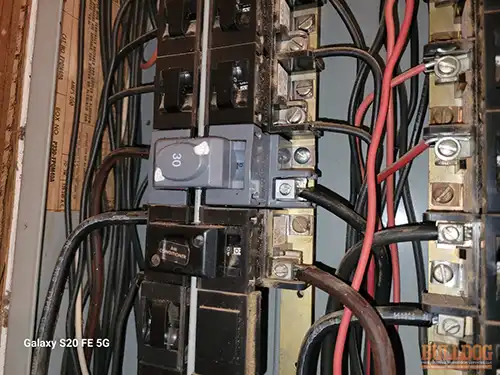
No official recall was ever issued for Pushmatic panels, though they’re widely considered obsolete and potentially problematic by electrical professionals in Kansas City, MO.
Pushmatic panels simply faded from the market when their parent company changed hands multiple times. The original Bulldog Electric Company was purchased by ITE (Gould) in 1976, which was then acquired by Siemens around 1984. The Pushmatic panel brand became redundant within Siemens’ existing product lines and was eventually discontinued, but this was a business decision rather than a safety-driven recall.
This lack of official recall creates confusion for homeowners in Kansas City, MO.
Unlike Federal Pacific panels where documented testing revealed high failure rates, Pushmatic panels never underwent comprehensive safety studies that would trigger formal recall proceedings. Some electricians defend these panels based on their heavy-duty bolt-on construction, while others flag them during inspections due to age-related reliability concerns that warrant panel replacement.
The Consumer Product Safety Commission didn’t mandate Pushmatic panel removal, and no court rulings declared them defective like those issued against Federal Pacific.
You’ll find debates among electrical professionals about whether functioning Pushmatic panels truly require immediate panel replacement or can continue operating with proper maintenance.
Most electricians in Kansas City, MO today recommend panel replacement not because of recall status, but because the panels are 50-70 years old with components operating beyond their expected service life. Modern panel replacement options offer 200-amp service capacity, GFCI/AFCI protection, and readily available replacement parts—advantages that decades-old Pushmatic panel equipment can’t match.
Insurance companies in Kansas City, MO often require panel replacement regardless of recall status, viewing the outdated technology as unacceptable risk even when the equipment appears functional.
Why do Pushmatic breakers become stiff and hard to reset?
Pushmatic panel breakers become stiff because they use grease-lubricated internal mechanisms that dry out over decades of sitting idle without regular exercise.
The push-button mechanism relies on grease to keep metal pivot points moving freely. When breakers aren’t pushed on and off regularly, the lubricating grease separates—the oil evaporates or drips away, leaving behind a soap-like carrier that absorbs moisture and promotes rust. As rust forms between moving and stationary parts, the mechanism requires increasing force to operate until it eventually jams completely.
This grease-fed design was common in the 1950s-1970s when Pushmatic panels were manufactured, but it requires monthly exercise to maintain proper function.
Homeowners in Kansas City, MO rarely if ever cycle their breakers, so the grease degrades steadily over 40-60 years of service. The spring mechanisms inside also weaken, corrode, and break as panels age beyond their design life.
You’ll notice stiffness when a breaker resists being pushed in or feels like it takes excessive force to reset.
Some breakers appear stuck in one position or won’t click positively into place. The most dangerous failure mode occurs when the internal mechanism jams so the breaker shows “off” externally while remaining electrically energized inside—creating shock risk for anyone assuming the circuit is dead and making panel replacement advisable.
Modern breakers don’t use grease-fed mechanisms, eliminating this maintenance requirement entirely.
They rely on spring tension and magnetic components that operate reliably without lubrication for decades.
Thing is, even regularly exercised Pushmatic panel breakers eventually fail as the grease breaks down from age. Some electricians in Kansas City, MO recommend monthly cycling to extend breaker life, but this only delays the inevitable panel replacement most 50+ year-old panels eventually require.
Can I still buy replacement Pushmatic breakers?
Yes, replacement breakers are still available, but they’re expensive, sometimes incompatible with older installations, and increasingly difficult to source.
UBI currently manufactures new Pushmatic panel breakers, though availability varies and prices run $40-60 for single-pole breakers compared to $8-15 for modern breakers. Connecticut Electric also produces UL-classified replacement breakers specifically tested for Pushmatic panels.
You’ll find used breakers through:
- Electrical salvage dealers
- Online marketplaces
- Specialty suppliers
Compatibility becomes a concern with 70+ years of manufacturing variations.
Here’s the compatibility problem: older installations from the 1950s and 1960s often won’t accept newer breakers manufactured in recent decades.
The physical dimensions changed slightly over the years, and forcing incompatible breakers into older panels can damage both the breaker and the bus bar. Some dual breakers designed for condensed spaces simply won’t fit in vintage installations due to internal blocking bars.
Finding specific breaker types presents another challenge.
You won’t find AFCI or GFCI Pushmatic panel breakers, which means you can’t meet modern electrical code requirements in Kansas City, MO for kitchen, bathroom, bedroom, and outdoor circuits when adding or remodeling. Two-pole breakers in higher amperages (50-100 amp) cost $100-200 when available at all.
Most electricians in Kansas City, MO stock common modern breakers but don’t carry Pushmatic panel inventory.
When your breaker fails, expect delays while specialty parts arrive. Some dealers sell refurbished breakers, raising questions about reliability when installing 40-year-old “new” parts.
By the time you replace multiple failed breakers at $40-60 each, you’re approaching the cost of a complete panel replacement that accepts readily available $10-15 breakers for future repairs.
How much does it cost to replace a Pushmatic electrical panel?

Panel replacement typically costs $1,500-$6,800 for residential installations in Kansas City, MO, with most homeowners paying $3,000-$4,500 depending on panel size, service upgrade requirements, and local permit fees.
Direct panel replacement swaps replacing 100-amp Pushmatic panel with modern 100-amp equipment run $1,500-$2,500 in most Kansas City, MO markets. This assumes straightforward installation with accessible panel location and no major code violations requiring correction. Adding a whole-house surge protector increases panel replacement costs by $300-600 but provides valuable protection for modern electronics.
Service upgrades from 100-amp to 200-amp service cost $3,000-$5,000 because electricians must replace the meter base, service entrance cable, and potentially the utility connection during panel replacement.
Many jurisdictions in Kansas City, MO require 200-amp minimum service for homes over 2,000 square feet or those adding major electrical loads like EV chargers, heat pumps, or central air conditioning.
Geographic location significantly affects panel replacement pricing—northeastern and western US installations run $4,000-$6,800 while southeastern and midwestern markets like Kansas City, MO see $2,500-$4,000 for comparable work.
Urban areas with higher labor rates and strict permitting add $500-$1,500 to panel replacement costs compared to rural locations.
Required code upgrades can inflate panel replacement costs substantially. Current code mandates AFCI breakers at $40-50 each for most circuits, hardwired smoke detectors, GFCI protection in kitchens and bathrooms, and proper grounding systems. These mandatory improvements add $800-$2,000 to panel replacement depending on home size and existing conditions.
Panel location affects panel replacement labor costs—panels mounted directly on concrete basement walls require plywood backing installation, exterior panels need weatherproof enclosures, and limited access areas increase panel replacement installation time by 30-50%.
Overhead versus underground service entry makes $500-$1,000 difference in total panel replacement project cost.
You should get 2-3 quotes from licensed electricians in Kansas City, MO and compare what’s included in panel replacement pricing.
Some contractors bundle these costs in their pricing while others charge separately:
- Permit fees
- Inspection costs
- Code upgrades
Most offer financing through contractor programs since few homeowners can pay $4,000-$5,000 out of pocket for panel replacement.
Insurance companies sometimes cover partial panel replacement costs when requiring panel replacement as condition of coverage, though homeowners typically pay deductibles and any upgrade expenses beyond basic panel replacement.
This Pushmatic panel represents a common electrical challenge I see in Kansas City, MO homes built between the 1950s and 1970s.
The panels worked reliably for decades, but age has caught up with them. When breakers become stiff or unreliable, you’re not just dealing with an inconvenience. You’re looking at real safety concerns that often require panel replacement.
The good news is you don’t have to figure panel replacement out alone.
A licensed electrician in Kansas City, MO can test your breakers, check panel condition, and give you a realistic assessment of whether you need panel replacement now or full panel replacement down the road. Most homeowners in Kansas City, MO pay $3,000-$4,500 for complete panel replacement upgrades, though panel replacement costs vary based on service capacity and code requirements.
The inspection this Kansas City, MO home received gives the buyer the facts they need to make informed decisions about their electrical system and potential panel replacement.
That’s what a proper home inspection in Kansas City, MO should do: identify real issues, explain why they matter, and provide context for smart planning including panel replacement options.
About the Author
Steve Rodriguez is a professional home inspector and the owner of Bulldog Professional Inspection Services. He performs more than 600 home inspections annually all across the KC metro area.
Based in: Raymore, MO
Service Areas: Belton, Raymore, Harrisonville, Grandview, Lee’s Summit, Blue Springs, Raytown, Independence, Liberty, Kansas City, MO, Kansas City, KS, Olathe, Leawood, Overland Park, Prairie Village, Shawnee, Lenexa
Certifications: Certified Master Inspector® (CMI). International Association of Certified Home Inspectors (InterNACHI) Certified Professional Inspector since 2004.
This article is based on a real inspection conducted in December 2025. The property address has been excluded for privacy. Cost estimates reflect Kansas City metro area pricing as of December 2025 and may vary based on specific conditions and contractor selection.
Helpful Links
- Check out our GBP post about this lesson
- Recent inspections in Kansas City, MO
- Home inspection lessons found in other Kansas City, MO homes
- Learn more about your electrical system in the Kansas City area
Schedule Your Home Inspection
Call: (816) 564-3081
Email: info@bulldoginspect.com
Schedule Your Inspection Online