






A home inspector’s discovery of a heavily rusted water heater in Shawnee homes, with replacement costs, melted heat traps, and end-of-life warning signs.
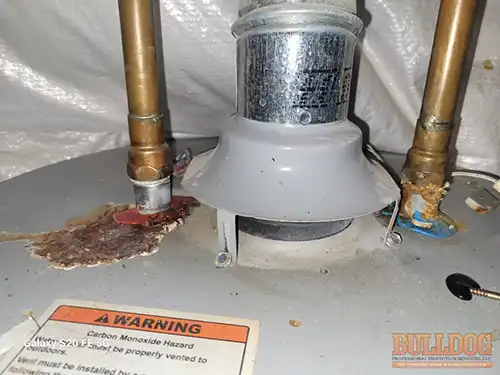
Friday afternoon during the plumbing inspection in the basement of a 9-year-old 2-story home in the Arbor Lake subdivision of Shawnee, I found a heavily rusted water heater with melted heat traps. The unit was at the end of its life, and the rust on the outside of the tank told the story of years of neglect.
Water heaters normally last 10-12 years. This unit had reached that age, but it showed all the warning signs of a water heater that hadn’t been maintained. The rust was on the outside of the tank.
Exterior rust and corrosion forms when moisture sits on the tank’s exterior for too long.
Leaky connections drip water onto the casing. Condensation forms and doesn’t dry. Over time, that moisture breaks down the paint and attacks the metal underneath. In Shawnee’s housing stock, water heaters fail at the end of their expected lifespan when maintenance gets ignored and small problems go unfixed.
Understanding Water Heater Rust: What It Is and Why It Fails
What Is a Water Heater and How Does Rust Form?
A water heater is a steel tank with a glass lining that stores and heats water for your home. It keeps hot water ready at a steady temperature, usually between 120-140 degrees. The tank has heating elements or burners, an anode rod to protect against premature corrosion, and valves to control temperature and pressure.
Rust forms in two places: inside the tank and outside the tank.
Internal rust forms when the barriers inside the tank fail and expose steel to water and oxygen.
Most water heaters have glass-lined steel tanks to stop this contact. The glass acts as a barrier between water and metal. But age, sediment, and overheating crack this glass layer. Once cracked, water reaches the steel beneath. The anode rod inside the tank attracts rust that would otherwise attack the internal tank walls. When anode rods aren’t replaced every two to three years, they wear out and can’t protect the tank from internal rust anymore.
External rust forms when moisture sits on the outside of the tank.
Leaky pipe connections drip water onto the casing. Condensation builds up from temperature differences and doesn’t dry properly. High humidity in basements adds moisture to the metal surfaces. Once the protective paint coating breaks down, water attacks the steel underneath.
Why Water Heaters Show External Rust
External rust happens when water heaters aren’t maintained and small moisture problems go unfixed. The most common causes are leaky connections at the top of the tank where supply lines connect, condensation at the bottom of the tank where cold water enters, and humid basement conditions that keep the tank’s exterior wet.
Shawnee’s water supply varies between city and well sources. Many areas have high mineral content. Hard water with calcium, magnesium, and iron creates more opportunities for leaks at connection points. Mineral deposits build up at pipe threads and create slow drips. These drips hit the outside of the tank and sit there long enough to start rust.
Temperature differences speed up external rust.
When cold water enters the bottom of a hot tank, condensation forms on the outside surfaces. If the basement doesn’t have good airflow, that condensation doesn’t evaporate. It sits on the metal. Over months and years, it breaks down the protective coating and creates rust spots that spread.
How External Rust Develops Over Time in Shawnee Water Heaters
External rust starts with small moisture problems.
- In years 1-3, loose connections create minor drips. Condensation forms at the bottom of the tank. The paint coating starts breaking down in spots where moisture hits regularly.
- Within 4-7 years, rust spots appear on the outside surfaces. The paint has worn away in problem areas. Water sits on bare metal. Rust spreads from connection points downward. The bottom of the tank shows rust stains where condensation collects.
- By years 8-10, external rust gets worse. The protective coating is gone in multiple areas. Rust has eaten into the metal casing. The heat traps at the water line connections show signs of heat damage from overheating. At this stage, the unit is at the end of its expected life and replacement makes more sense than repair.
Here are the questions homebuyers ask most about rusted water heaters:
What causes water heaters to rust?
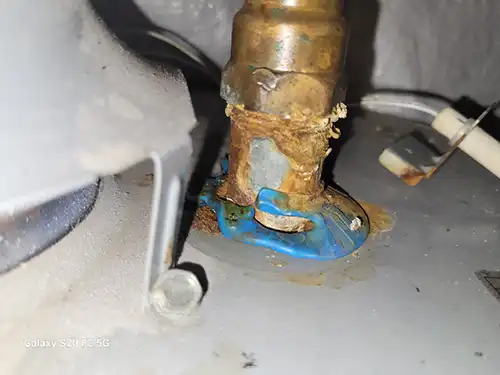
Water heaters rust in two different places: inside the tank and outside the tank.
Internal rust happens when the anode rod wears out.
The anode rod is a steel rod coated in aluminum, magnesium, or zinc that runs the full length of the tank. It attracts rust that would otherwise attack the internal tank walls. When anode rods aren’t replaced every two to three years, they wear out and can’t do their job. Water heaters that never get new anode rods often develop internal rust and fail before 10 years.
External rust happens when moisture sits on the outside of the tank.
Leaky connections at the top where supply lines attach drip water onto the tank’s exterior. Condensation forms at the bottom where cold water enters a hot tank. High humidity in basements keeps metal surfaces wet. Once the protective paint coating breaks down, water attacks the steel underneath and rust spreads.
Hard water speeds up both types of damage.
Water with high mineral content creates sediment at the bottom of the tank. This sediment has calcium, magnesium, and iron. It insulates the tank and forces the water heater to run longer and hotter than it should. This speeds up anode rod wear inside the tank. It also creates more mineral deposits at pipe connections, which lead to leaks and drips that cause external rust.
Temperature settings affect how long the system lasts.
Lower water temperatures extend the life of both the anode rod and the tank. The lower the temperature, the longer the life. The hotter the system runs, the faster both internal and external problems develop. In Shawnee’s climate, where water heater temperature setting affects corrosion and tank lifespan, hard water is common and adds to faster rust development.
How can you tell if your water heater is rusting internally versus externally?
You can tell where your water heater is rusting by looking at four different signs.
- Internal rust shows up in your water. If your hot water comes out brown, orange, or red while cold water runs clear, the problem is inside your water heater. Rust particles from the corroded internal tank walls get into the water as it passes through. Test this by draining a couple gallons from the tank’s drain valve. If the water is discolored, internal rust exists. A missing or badly corroded anode rod confirms internal rust. When you look inside the tank and don’t see an anode rod, or the rod is down to a thin wire core, your tank has lost its main defense against internal corrosion.
- External rust shows up on the outside of the tank. If you spot rust on the metal casing, especially near the bottom or around pipe connections at the top, water has been hitting the outside surfaces. This often happens when there’s a leaky connection between the water heater and supply pipes. Water drips onto the tank and causes surface rust. You’ll see brown or orange staining on the painted metal surfaces. The paint may be bubbling or flaking off in rusty areas.
- Metallic-tasting water signals advanced internal rust. When rust particles dissolve into your hot water from corroded internal tank walls, they create a distinct metallic taste. This means the rust has gone beyond surface rust inside and is actively getting into your water. Stop using the water until a plumber inspects the unit.
- Water heater leaks can come from either internal or external rust. Leaks at pipe connections near the top often mean external rust has damaged the casing where fittings attach. Leaks at the base of the tank or from the tank itself mean internal rust has eaten through the tank’s walls and created holes. In Shawnee homes with hard water, these signs show up in water heaters between 8 and 12 years old.s near the top often mean internal rust has damaged the tank. In Shawnee homes with hard water, these signs show up in water heaters between 8 and 12 years old.
What does rust on a water heater mean?
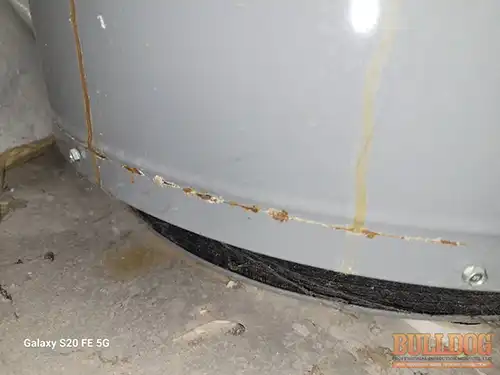
Rust on a water heater means moisture has been attacking the metal. The location tells you what kind of problem you’re dealing with.
Rust on the outside tank surface means moisture problems from leaks or condensation. If you spot rust on the outside metal, especially near the bottom or around pipe connections at the top, water is hitting the outside casing. This happens when there’s a leaky connection between the water heater and supply pipes, or when condensation forms and doesn’t dry. Water sits on the tank and causes surface rust. A plumber can fix the leak, improve ventilation, and clean minor surface rust. Heavy external rust on an older unit usually means the protective coating is gone and replacement makes more sense than repair.
Rust around the pressure relief valve suggests moisture at the connection point. The temperature and pressure relief valve is a safety feature that releases water if conditions inside the tank get dangerous. Rust around this valve means water has been leaking or dripping at this connection.
Rusty water from hot taps means internal tank rust. When brown or reddish water flows from your faucets every time you use hot water, the anode rod has worn out and the internal tank walls have rusted through. The glass lining that protects the steel tank has worn away, letting water contact the metal directly. This creates rust particles that get into your water supply. There’s no safe way to repair internal tank rust. The tank’s structure is damaged, and replacement is necessary.
In Shawnee’s 9-year-old homes, rust usually starts to show up when units reach the end of their expected 10-12 year lifespan. Water heaters that were never maintained can show both external rust from neglected leaks and internal rust from worn-out anode rods.
Can a rusted water heater be repaired or does it need replacement?
A rusted water heater can sometimes be repaired if the rust is only on the outside and the tank is still relatively young, but most rusted units at 8-10 years old need complete replacement. The location of the rust and the age of the unit determine your options.
External rust may be manageable on younger units.
If rust appears on the outside of the tank from leaks or condensation and the unit is only 5-7 years old, a plumber can fix the moisture source and clean the rust. This involves tightening connections, replacing worn parts, stopping leaks, and improving basement ventilation. But if the outside rust is heavy and the unit is 8-10 years old, replacement makes more financial sense than trying to save an aging tank.
Internal tank rust can’t be repaired.
Once the glass lining inside the tank cracks and rust forms on the steel walls, the tank’s structure is damaged. This happens when the anode rod wears out and stops protecting the internal surfaces. There’s no cost-effective way to re-line the interior or reverse rust that has gotten into the tank itself. At this stage, replacement is the only safe option. The corroded metal becomes brittle and prone to failure as the tank expands and contracts with temperature changes.
Minor repairs work for specific problems.
If internal rust hasn’t started yet and the anode rod is the only corroded component, replacing it quickly and cheaply prevents further deterioration. Rust around pipe fittings or the temperature-pressure relief valve can be fixed by tightening connections, replacing worn parts, or stopping moisture problems. These repairs cost between $150 and $300.
Age matters when deciding between repair and replacement.
Most water heaters last 10-12 years. If your unit is 8-10 years old and showing either external or internal rust, replacement makes more financial sense than repairs. In Shawnee, where hard water is common, water heaters without regular maintenance often reach the end of their life at 9-10 years. If your water heater needs two or more repairs and it’s near 10 years old, buying a new energy-efficient unit is more cost-effective.
How much does it cost to repair a rusty water heater?
Repairing a rusty water heater costs between $150 and $700 for minor fixes, but units at the end of their 10-12 year lifespan with heavy rust require full replacement at $875 to $1,800. The specific repair cost depends on whether the rust is internal or external and whether the tank itself is damaged.
Fixing external rust from leaky connections costs $150 to $200.
When loose valves or worn pipe fittings drip water onto the tank’s outside surfaces, surface rust develops. A plumber can tighten connections, replace bad valves, seal leaks, and clean minor rust for minimal cost. Temperature-pressure relief valve replacement runs $100 to $200 for parts and labor. Improving basement ventilation to reduce condensation may add another $100 to $300 depending on the work needed.
Anode rod replacement prevents internal deterioration and costs $250 to $300 including parts and labor.
If internal rust hasn’t started yet, replacing a worn anode rod stops corrosion from developing inside the tank. This repair extends the water heater’s life significantly. Plumbers recommend inspecting anode rods every six to 12 months and replacing them every two to three years regardless of visible rust. But if internal rust has already formed and you’re seeing discolored water, anode rod replacement won’t fix the existing damage.
Tank flushing addresses sediment buildup for $150 to $200. Hard water sediment speeds up both internal and external problems by creating hot spots and forcing the tank to overheat. Annual flushing removes mineral buildup and reduces stress on the system. But flushing can’t reverse rust that has already formed inside or outside the tank.
Full replacement becomes necessary when rust has damaged the tank structure or the unit has reached 9-10 years old with multiple problems.
Water heater replacement costs $875 to $1,800 for standard 40-50 gallon units, with installation included. Gas units cost more than electric models. In Shawnee, where hard water is common, replacement often makes more sense than repairs on units over 8-10 years old. If repair estimates exceed $300 and the unit is 9-10 years old, replacement provides better long-term value and improved energy efficiency.
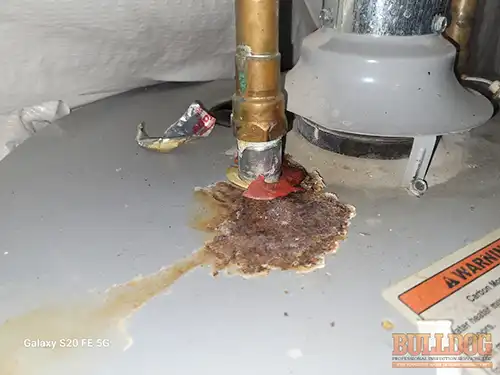
Water heater rust in Shawnee’s 9-year-old homes isn’t unexpected. These units have reached the end of their normal 10-12 year lifespan. External rust from neglected leaks and poor ventilation combines with internal rust from worn anode rods to create the warning signs of a failing system.
About the Author
Steve Rodriguez is a professional home inspector and the owner of Bulldog Professional Inspection Services. He performs more than 600 home inspections annually all across the KC metro area.
Based in: Raymore, MO
Service Areas: Belton, Raymore, Harrisonville, Grandview, Lee’s Summit, Blue Springs, Raytown, Independence, Liberty, Kansas City, MO, Kansas City, KS, Olathe, Leawood, Overland Park, Prairie Village, Shawnee, Lenexa
Certifications: Certified Master Inspector® (CMI). International Association of Certified Home Inspectors (InterNACHI) Certified Professional Inspector since 2004.
This article is based on a real inspection conducted in December 2025. The property address has been excluded for privacy. Cost estimates reflect Kansas City metro area pricing as of December 2025 and may vary based on specific conditions and contractor selection.
Helpful Links
- Check out our GBP post about this lesson
- Recent inspections in Shawnee, KS
- Home inspection lessons found in other Shawnee, KS homes
- Learn more about plumbing systems in the Shawnee area
Schedule Your Home Inspection
Call: (816) 564-3081
Email: info@bulldoginspect.com
Schedule Your Inspection Online