







A home inspector’s discovery of weak I-beam anchoring in a Kansas City home, with repair costs, warning signs, and proper installation standards.
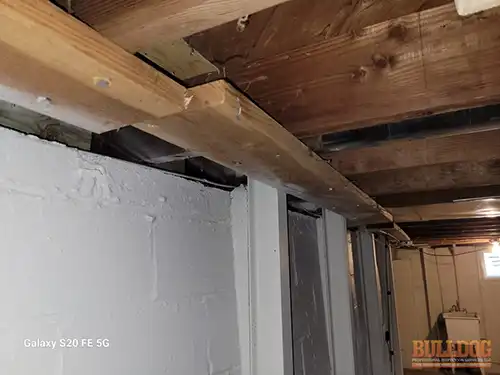
Yesterday afternoon during the foundation inspection of ranch-style home in Kansas City’s Marlborough Heights subdivision, I found steel I-beams installed on all four basement walls of a 100-year-old ranch home.
The beams indicated the foundation had experienced significant inward movement at some point in the past.
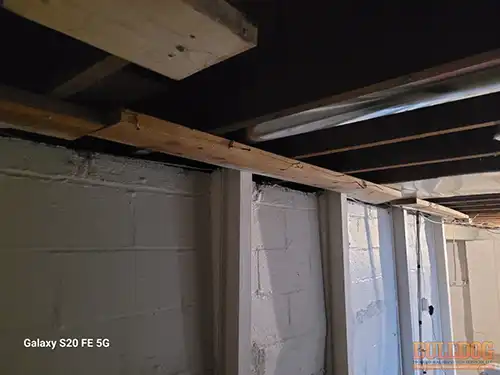
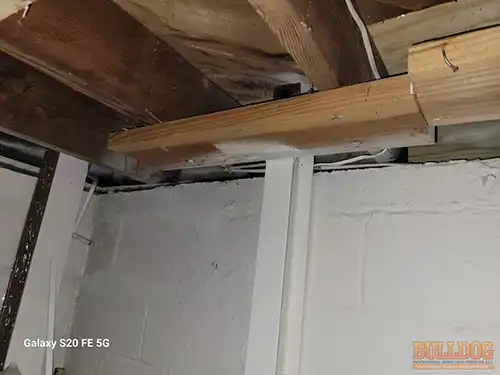
Three walls used proper steel angle irons to anchor the I-beams at the top. The north wall, the front of the house, used single 2×6 wood boards instead.
This is a foundation repair that looks right until you examine how it’s anchored.
Wood is soft and compresses under constant lateral pressure from soil pushing against the foundation. An un-sistered single-layer 2×6 board isn’t adequate to hold a steel I-beam in place over the long term, especially when that beam is resisting thousands of pounds of force from Kansas City’s expansive clay soil.
In Kansas City’s housing stock, I find improper foundation repairs in approximately 15% of homes over 75 years old that have had previous structural work.
The issue is more common in homes where repairs were completed decades ago using outdated methods or by contractors who cut corners on materials. This isn’t a cosmetic problem. Inadequate I-beam anchoring means the repair may fail when soil pressure increases during wet seasons, and the wall will resume moving inward.
Understanding Foundation I-Beam Repairs: What They Are and Why Anchoring Matters
A foundation I-beam repair stabilizes basement walls that have bowed inward from lateral soil pressure. Steel I-beams are installed vertically against the affected wall and anchored at both the basement floor and the floor joists above, creating a rigid barrier that prevents further inward movement.
Why I-Beam Repairs Are Used
Foundation walls bow inward when external forces exceed the wall’s ability to resist lateral pressure.
In Kansas City, the primary causes are expansive clay soil that swells when wet, hydrostatic pressure from poor drainage, and freeze-thaw cycles that push saturated soil against the foundation. Older block foundations like those built in the 1920s are particularly vulnerable because they lack the steel reinforcement found in modern construction.
I-beam repairs work by transferring the lateral load from the foundation wall to the home’s structural frame above and the concrete floor below.
When properly installed, the I-beam creates a load path that bypasses the compromised foundation wall entirely. The wall stops moving because the I-beam prevents it from deflecting further inward.
How I-Beam Anchoring Works
The effectiveness of an I-beam repair depends entirely on the anchoring system at the top and bottom of each beam.
At the bottom, contractors jackhammer through the basement floor to create a 12-inch diameter hole, then set the I-beam in concrete to form a permanent footer. This bottom anchor prevents the beam from sliding or sinking under load.
At the top, the I-beam extends into the joist bay between floor joists. Steel angle irons or steel blocking spans across multiple joists, clamping the I-beam tightly against the foundation wall. This top anchor transfers lateral forces from the wall directly into the floor framing system.
The critical distinction between proper and improper anchoring is material choice.
Steel angle irons maintain constant pressure because steel doesn’t compress or deform under load. Wood blocking has a much greater chance of compressing gradually under the same forces, allowing the I-beam to shift away from the wall over time.
Regional Context in Kansas City
Kansas City’s clay soil creates unique challenges for foundation repairs.
Clay expands dramatically when saturated and shrinks when dry, creating a constant push-pull cycle against foundation walls. Homes in older neighborhoods like Marlborough Heights were built before modern foundation engineering standards, often with unreinforced block foundations that can’t resist these lateral forces.
I’ve inspected foundations in Marlborough Heights, Ivanhoe, and Volker that show this same pattern: original block foundation, evidence of past inward movement, I-beam repair installed sometime in the 1980s or 1990s, and varying quality in the anchoring system used.
Here’s what homebuyers need to know about improper I-beam repairs:
Can a bowing foundation wall be fixed with I-beams?
A bowing foundation wall can be fixed with I-beams, but the I-beams stabilize the wall rather than straighten it back to its original position.
Steel I-beams installed vertically against a bowed basement wall with mortar installed between the wall and beam are designed to prevent further inward movement by anchoring to both the basement floor and the floor joists above. This creates a rigid barrier that counteracts the lateral soil pressure pushing against the foundation.
The installation process involves placing 4-inch steel I-beams every 4 to 6 feet along the affected wall.
Each beam is secured at the bottom by breaking through the basement floor and setting the beam in concrete, creating a permanent footer. At the top, the beam extends into the joist bay where steel or wood blocking spans the joists to hold the I-beam tight against the wall. This dual-anchor system transfers the load from the bowing wall to the home’s structural frame and the concrete floor.
Steel I-beams work best for walls that have bowed 2 inches or less and don’t require active straightening.
They’re particularly effective in Kansas City homes where excavating the exterior isn’t feasible due to landscaping, patios, or proximity to neighboring properties. The beams also work on both poured concrete and concrete block foundation walls.
The limitation is that I-beams hold the wall in its current position rather than pulling it back to vertical.
If you need the wall straightened, wall anchors or helical tiebacks that pull from the exterior soil are better options. However, for stabilization without exterior excavation, I-beams provide permanent reinforcement. In Kansas City’s clay soil conditions where foundation movement is common, I-beams installed correctly can last the lifetime of the home.
For a 100-year-old block foundation like the one in Marlborough Heights, I-beams are often the preferred solution when the wall has already been repaired once and needs additional support to prevent future movement.
How are steel I-beams anchored to foundation walls?
Steel I-beams are anchored to foundation walls using a dual-anchor system that secures the beam at both the floor and ceiling level.
The bottom anchor involves breaking through the basement floor with a jackhammer to create a 12-inch diameter hole at each beam location. The I-beam is set into this hole and surrounded with concrete to create a permanent footer that distributes the load into the ground. This bottom anchor prevents the beam from sliding or shifting when soil pressure pushes against the foundation wall.
At the top, the I-beam extends up into the joist bay between the floor joists. Steel angle irons or wood blocking spans across multiple joists, clamping the top of the I-beam tightly against the foundation wall. This top anchor transfers the lateral load from the bowing wall directly into the floor framing system above. The angle iron creates a rigid connection that prevents the beam from rotating or pulling away from the wall.
The proper anchoring method depends on whether you’re stabilizing an existing bowed wall or installing I-beams during new construction.
For foundation repairs in existing homes, the angle iron method is standard because it doesn’t require welding and can be installed with through-bolts. For new construction, beams may sit in pockets cast into the foundation wall, but repair applications require the floor-and-ceiling anchor approach.
In Kansas City foundation repairs, contractors space I-beams 4 to 6 feet apart depending on the wall material.
Concrete block walls typically need closer spacing (3 to 4 feet) than poured concrete walls (4 to 5 feet) because block is more vulnerable to lateral pressure.
The critical element is that both anchors must be present. An I-beam secured only at the bottom or only at the top won’t effectively resist the continuous lateral pressure from Kansas City’s expansive clay soil. The dual-anchor system creates a rigid column that locks the wall in place and prevents further inward movement.
What causes foundation I-beams to fail?
Foundation I-beams fail when the anchoring system at either the top or bottom becomes inadequate to resist lateral soil pressure.
The most common failure point is improper top anchoring, especially when contractors use wood instead of steel to secure the I-beam to the floor joists above.
Wood compresses and deforms under constant pressure, sometimes allowing the I-beam to shift away from the wall over time. Steel angle irons or steel blocking maintains rigid contact between the I-beam and the wall indefinitely.
Inadequate bottom anchoring also causes I-beam failure.
When the concrete footer beneath the I-beam is too shallow or too narrow, the beam can sink into the basement floor under load. The footer must extend below the frost line and be at least 12 inches in diameter to distribute weight properly. Undersized footers may allow the beam to settle, creating gaps between the I-beam and the foundation wall that eliminate the stabilizing effect.
Insufficient beam spacing creates failure even when individual I-beams are properly anchored.
When beams are spaced more than 6 feet apart, the unsupported wall sections between beams may continue to bow inward. Kansas City’s clay soil exerts tremendous lateral pressure during wet periods, and widely spaced I-beams will have a hard time preventing movement in the sections they don’t directly support.
Material degradation causes long-term I-beam failure in damp basements and crawlspaces.
Steel I-beams rust when exposed to moisture, especially at the floor level where water accumulates. Wooden I-beams rot when crawlspaces lack proper ventilation or when plumbing leaks introduce moisture. Once corrosion or rot weakens the beam’s cross-section, it no longer has the original strength necessary to resist the design loads.
Soil conditions outside the foundation also contribute to I-beam system failure.
When gutters dump water directly against the foundation or yard grading slopes toward the house, hydrostatic pressure increases beyond what the I-beam system was designed to handle. Even properly installed I-beams can struggle to compensate for poor drainage that continuously adds lateral load to the foundation wall.
How long do steel I-beam foundation repairs last?
Steel I-beam foundation repairs last 25 to 50 years when properly installed and maintained, with some systems carrying lifetime warranties transferable to future homeowners.
The longevity depends primarily on three factors:
- Anchoring quality
- Moisture control
- Ongoing soil conditions around the foundation
I-beams anchored with steel angle irons at the top and concrete footers at the bottom last significantly longer than beams using wood blocking or inadequate footers.
Steel angle irons don’t compress or deteriorate like wood, maintaining constant pressure between the I-beam and the foundation wall. When contractors use 4-inch steel I-beams spaced appropriately and anchored correctly, the repair can last as long as the home itself.
Moisture control directly affects I-beam lifespan.
Steel beams in dry basements with proper ventilation can show minimal corrosion after decades of service. However, beams in damp crawlspaces or basements with water intrusion develop rust that weakens structural integrity. Applying rust-resistant coatings and maintaining basement humidity below 60% extends I-beam life considerably.
Ongoing soil conditions also determine whether the repair remains effective.
I-beams installed in homes with good drainage, proper yard grading, and functional gutters can maintain their stabilizing effect indefinitely. When water continues to accumulate against the foundation, increasing lateral pressure can eventually overwhelm even properly installed I-beams. Kansas City’s expansive clay soil requires homeowners to manage drainage actively to protect foundation repairs long-term.
Many foundation repair companies in the Kansas City area offer 25-year limited warranties on I-beam installations when they also install proper concrete footers. Some companies provide lifetime warranties that transfer when you sell the home, adding value and buyer confidence. The warranty typically requires maintaining above-freezing temperatures and managing moisture to prevent footer heaving or beam corrosion.
In practice, I-beams installed in the 1980s and 1990s across Kansas City continue to function effectively today when homeowners maintained drainage and controlled basement moisture. The repair method has proven itself over multiple decades in local clay soil conditions.
How much does steel I-beam foundation repair cost?
Steel I-beam foundation repair costs between $800 and $4,000 per beam in the Kansas City area, with most homeowners spending $200 to $500 per linear foot for complete installation. The total project cost depends on:
- How many beams your foundation needs
- The spacing between them
- Whether additional work like excavation or drainage correction is required
Cost Breakdown by Project Scope
For a typical 20-foot foundation wall requiring 4 to 5 I-beams spaced 4 to 5 feet apart, expect to pay $3,200 to $10,000. This includes:
- 4-inch steel I-beams
- Concrete for footers
- Steel angle irons for top anchoring
- Labor for jackhammering through the basement floor
- Securing the beams to floor joists
If the wall is concrete block rather than poured concrete, you’ll need closer beam spacing (3 to 4 feet apart), which can increase material and labor costs by 20 to 30%.
Labor costs in Kansas City run $50 to $150 per hour for qualified foundation repair contractors. The installation typically takes 1 to 2 days depending on how many beams are needed and accessibility in the basement. Difficult access or the need to move utilities will impact labor time and cost.
Additional expenses include:
- Structural engineer assessments ($350 to $800)
- Building permits ($75 to $150)
- Concrete work for new footers beneath each I-beam ($100 to $200 per footer)
If your foundation repair requires addressing the underlying cause, such as installing gutters, regrading the yard, or adding exterior drainage, plan on these improvements adding $1,000 to $5,000 to the total project cost.
The most affordable I-beam repairs involve simply stabilizing a slightly bowed wall without straightening it.
This requires fewer beams and no exterior excavation, keeping costs at the lower end of the range. Repairs requiring wall straightening, extensive beam coverage, or waterproofing push costs toward $15,000 to $25,000.
Kansas City’s clay soil conditions mean foundation repairs often need drainage improvements to prevent future movement, so budget for comprehensive solutions rather than I-beams alone.
Improper I-beam anchoring in Kansas City ranch homes isn’t an isolated problem.
It’s a predictable failure pattern that appears, especially when contractors substitute wood blocking for steel angle irons at the top anchor point. The repair might look complete from a distance, but the wood can compress under load, allowing the I-beam to shift and the foundation wall to resume moving inward.
In a 100-year-old home where previous foundation repairs used inadequate materials, the buyers now face a decision about upgrading the north wall anchoring to match the proper steel angle irons used on the other three walls.
About the Author
Steve Rodriguez is a professional home inspector and the owner of Bulldog Professional Inspection Services. He performs more than 600 home inspections annually all across the KC metro area.
Based in: Raymore, MO
Service Areas: Belton, Raymore, Harrisonville, Grandview, Lee’s Summit, Blue Springs, Raytown, Independence, Liberty, Kansas City, MO, Kansas City, KS, Olathe, Leawood, Overland Park, Prairie Village, Shawnee, Lenexa
Certifications: Certified Master Inspector® (CMI). International Association of Certified Home Inspectors (InterNACHI) Certified Professional Inspector since 2004.
This article is based on a real inspection conducted in December 2025. The property address has been excluded for privacy. Cost estimates reflect Kansas City metro area pricing as of December 2025 and may vary based on specific conditions and contractor selection.
Helpful Links
- Check out our GBP post about this lesson
- Recent inspections in Kansas City, MO.
- Home inspection lessons found in other Kansas City, MO homes
- Learn more about your foundation in the Kansas City area
Schedule Your Home Inspection
Call: (816) 564-3081
Email: info@bulldoginspect.com
Schedule Your Inspection Online