






A master home inspector’s response to electrical service mast installations in Kansas City homes, with safety warnings and repair guidance

If you own a home or are looking to invest in property, you’ve likely seen a metal pipe sticking out of a roof with heavy wires attached to it. That pipe is your electrical service mast, and it is a critical piece of your home’s infrastructure.
During the recent electrical inspection of a 64-year-old ranch-style home in the Park Lane subdivision of Kansas City, MO last Tuesday afternoon, I came across a perfectly executed electrical service mast installation that featured a heavy-duty guy wire system.
This situation reminded me of a blog post I wrote back in December about a missing guy wire and how often these systems are overlooked and misunderstood. Whether you are a first-time homebuyer or a seasoned real estate investor, understanding the structural needs of your electrical system can prevent costly repairs and safety hazards.
In this guide, we will break down the essential rules for these masts and the specific guy wire requirements for service mast stability.
What is the NEC code for service masts?

The NEC code for service masts is the set of national safety standards—specifically Section 230.28—that dictates how your electrical mast must be built to handle the physical weight of power lines. When performing an electrical service mast installation, following these rules is non-negotiable for safety and passing inspections.
NEC Section 230.28: Structural Strength
The code requires that every mast be of “adequate strength” to withstand the constant tension from the utility company’s service-drop conductors. If the mast isn’t strong enough on its own, it must be reinforced with braces or guy wires. In our local Kansas City, MO climate, this strength is vital for surviving ice storms and high winds that can pull on those lines.
Permitted Attachments
It is important to know that the electrical mast is strictly for power. National code prohibits attaching “non-electrical” items like satellite dishes, telephone lines, or cable TV wires to the mast. These extra attachments add “wind load” and stress that the pipe wasn’t designed to handle, which could lead to a structural failure.
Component Labeling and Hubs
Every piece of hardware used in the system, specifically the hubs where the conduit meets the meter box, must be UL-listed and identified for use with service-entrance equipment. You can verify these standards through the National Electrical Code (NEC) guidelines to ensure your home meets the highest safety benchmarks.
How high can a service mast be without guy wires?

The height a service mast can reach without guy wires is typically limited to 36 inches above the roofline to ensure structural stability. When planning an electrical service mast installation, maintaining this height ratio is vital because the higher the mast extends, the more leverage the heavy utility lines have to bend or snap the conduit.
The 36-Inch Standard
A service mast can generally extend up to 3 feet without needing additional support from braces or wires. If your home in Kansas City, MO requires the mast to poke up higher than 36 inches to clear a neighboring structure or a porch, the guy wire requirements for service mast safety automatically kick in. This standard prevents the “lever effect” from damaging your roof or pulling the meter socket off the side of your house.
Maximum Height Limits
While 3 feet is the tipping point for support, most local codes set a maximum total height—often 48 to 60 inches—that a mast can reach even with supports. If your service drop requires more height than that, you may need to move the service location or install a permanent “stiff leg” brace rather than a standard guy wire.
Attachment Points
The attachment point for the power lines must be positioned correctly to balance clearance and tension. Ideally, the utility wires should attach to the mast between 18 and 36 inches above the roof surface. If the attachment point is too low, you won’t have enough clearance; if it is too high without a guy wire, the mast becomes a structural liability during a heavy Missouri windstorm.
Are guy wires permitted for support of a service mast?

Yes. Guy wires are permitted for support of a service mast as a recognized and effective method for stabilizing the conduit against the tension of the incoming power lines. In fact, for many electrical service mast installation projects in Kansas City, MO, guy wires are the preferred solution when a rigid brace cannot be easily attached to the roof framing.
Guying vs. Bracing
Guy wires are permitted as a flexible yet high-strength alternative to rigid pipe bracing. While a rigid brace uses a solid metal pole to push back against the tension of the power lines, a guy wire system uses high-tension cables to pull the mast in the opposite direction of the utility pole. Both methods satisfy the guy wire requirements for service mast stability, provided they are anchored into the structural members of the home rather than just the roof shingles.
Mast Material Requirements
To use guy wires effectively, the mast itself must be constructed from specific heavy-duty materials. For any installation extending above the roofline, the NEC requires the use of Galvanized Rigid Conduit (GRC) or Intermediate Metal Conduit (IMC). Standard thin-wall conduit (EMT) is never permitted for a service mast because it lacks the structural integrity to withstand the “pull” of the wires, even if a guy wire system is installed.
Strain Capacity
The guy wire system must be designed to handle the specific strain capacity imposed by the utility company’s service drop. In the Kansas City, MO area, these lines are often under significant tension to keep them from sagging over streets or driveways. A properly installed guy wire system must be capable of counteracting hundreds of pounds of pull, ensuring the mast remains perfectly vertical even when ice accumulates on the power lines during a Midwestern winter.
What are the requirements for guy wires?

The guy wire requirements for service mast stability include specific rules regarding the materials, angles, and anchoring methods used to secure the conduit. During a professional electrical service mast installation, these requirements ensure that the tension from the heavy utility lines is safely transferred into the home’s structural frame rather than the electrical equipment.
Installation Angles
The requirements for guy wire angles state that the wire should ideally extend at a 45-degree angle from the mast to the roof or wall anchor. This 45-degree “sweet spot” provides the best mechanical advantage to counteract the horizontal pull of the service drop. If the angle is too steep or too shallow, the guy wire loses its effectiveness, which can lead to the mast leaning or vibrating excessively during high winds in Kansas City, MO.
Anchor Spacing
Proper anchor spacing requires that the wires be positioned to provide balanced support, usually spaced 120 degrees apart if using a three-wire system or 90 degrees for a four-wire setup. However, in many residential electrical service mast installation scenarios, a single or double guy wire is used to pull directly opposite the utility pole. Regardless of the count, these anchors must be bolted into solid structural wood—like a rafter or a wall stud—rather than just the roof decking or siding.
Hardware Specs
The hardware specs for a compliant system require corrosion-resistant materials, typically galvanized steel cables with a minimum diameter of 1/4 inch. The system must also include heavy-duty screw eyes, thimbles to prevent wire fraying, and turnbuckles to allow for precise tension adjustment. In 2026, inspectors in Kansas City, MO also look for high-quality insulators if the guy wire is positioned in a way that it could potentially contact energized conductors.
How high should a service mast be for clearance?
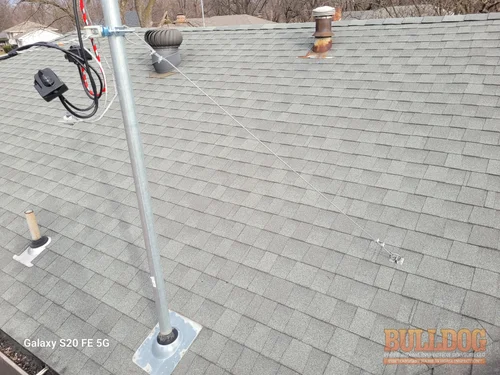
The height a service mast should be for clearance is determined by the need to keep high-voltage lines a safe distance from pedestrians, vehicles, and the roof surface itself. When finishing an electrical service mast installation, the final height is often a balance between meeting these safety clearances and adhering to the guy wire requirements for service mast stability to handle the extra height.
Ground Clearances
How high the mast must be depends largely on what is passing underneath the wires. In Kansas City, MO, the standard ground clearance is 12 feet over residential property and walkways, but this increases to 18 feet if the wires cross over a driveway or public street. Ensuring your mast is tall enough to maintain these heights is a primary goal of any modern electrical service mast installation to prevent accidental contact with vehicles or equipment.
Roof Clearances
The height requirements for wires passing over a roof generally dictate a vertical clearance of at least 8 feet. However, there are common exceptions: if the roof has a steep slope (a 4:12 pitch or greater), that clearance can often be reduced to 3 feet. This is why you frequently see guy wires on older homes in Kansas City, MO—the mast must be tall enough to keep the wires at a safe distance from the shingles, often requiring it to exceed the 36-inch “unsupported” height limit.
Drip Loop Requirements
A service mast must be high enough to allow for a proper drip loop, and you can follow this homeowner’s guide to service mast maintenance to see how these components work together to keep your home’s electrical system dry.
The drip loop is a downward curve in the wires that prevents rainwater from following the cable directly into the mast and your electrical panel. By ensuring the mast height is sufficient, you create enough space for this loop to hang below the point of attachment, keeping your home’s electrical guts dry and safe.
Action Plan for Kansas City, MO Homeowners
If you are looking at your electrical meter and noticing a leaning pipe or sagging wires, follow this strategic plan to ensure your home remains safe and compliant:
- Perform a Visual Inspection: Check if your mast extends more than 3 feet above the roofline. If it does and lacks support, it likely does not meet the guy wire requirements for service mast safety. Pay close attention to the roofline electrical mast support; if the pipe looks like it is pulling away from the eaves, it needs immediate attention.
- Evaluate Your Hardware: Check if your current setup uses a professional electrical mast guy wire kit or a “DIY” solution. A proper kit will include galvanized aircraft cable, heavy-duty turnbuckles, and reinforced roof plates designed to withstand the high-tension pull of utility lines.
- Check for NEC Code Compliance: Review the NEC code for service masts to ensure no prohibited items, like internet cables or satellite dishes, are attached to the conduit.
- Consult a Local Professional: Contact a licensed electrician in Kansas City, MO to evaluate your electrical service mast installation. They can verify if your system meets the 2026 local utility standards and structural requirements.
A well-installed service mast is the backbone of your home’s connection to the power grid. By understanding the NEC code for service masts, height limits, and the necessity of using a high-quality electrical mast guy wire kit, you can ensure your property remains safe and structurally sound.
Whether you are buying, selling, or maintaining a home in Kansas City, MO, paying attention to your roofline electrical mast support today can prevent major electrical headaches tomorrow. A small investment in proper guy wire requirements for service mast stability is the best way to protect your home from the unpredictable Midwestern weather.
About the Author
Steve Rodriguez is a professional home inspector and the owner of Bulldog Professional Inspection Services. He performs more than 600 home inspections annually all across the KC metro area.
Based in: Raymore, MO
Service Areas: Belton, Raymore, Harrisonville, Grandview, Lee’s Summit, Blue Springs, Raytown, Independence, Liberty, Kansas City, MO, Kansas City, KS, Olathe, Leawood, Overland Park, Prairie Village, Shawnee, Lenexa
Certifications: Certified Master Inspector® (CMI). International Association of Certified Home Inspectors (InterNACHI) Certified Professional Inspector since 2004.
This article is based on a real inspection conducted in [Month YYYY – PLACEHOLDER]. The property address has been excluded for privacy. Cost estimates reflect Kansas City metro area pricing as of [Month YYYY – PLACEHOLDER] and may vary based on specific conditions and contractor selection.
Helpful Links
- Check out our GBP post about this lesson
- Recent inspections in Kansas City, MO
- Home inspection lessons found in other Kansas City, MO homes
- Learn more about your electrical system in the Kansas City area
Schedule Your Home Inspection
Call: (816) 564-3081
Email: info@bulldoginspect.com
Schedule Your Inspection Online