A home inspector’s guide to identifying zinc oxide on furnace vents in Kansas City homes, with costs, carbon monoxide risks, and repair timelines.
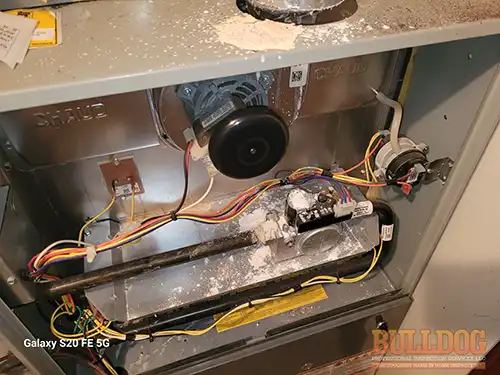
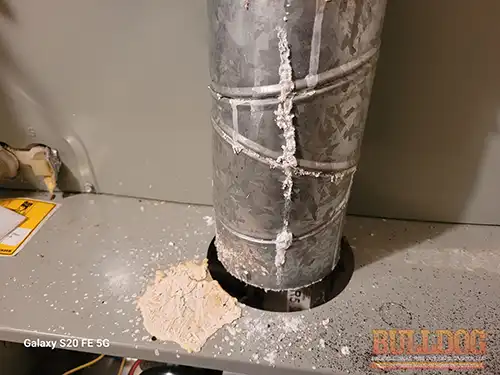
Thursday afternoon during the HVAC inspection of a vacant 58-year-old ranch in Kansas City, KS’s Cedarholm subdivision, I found white powder leaking from the seams of the furnace exhaust vent.
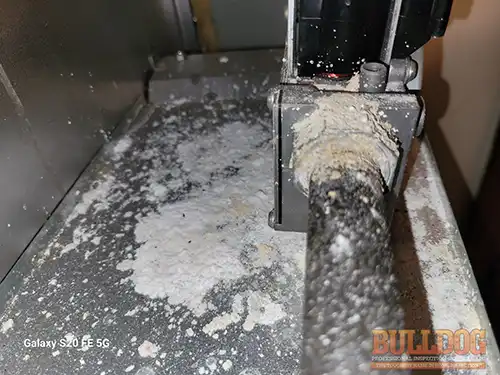
The powder was piling up on top of the furnace and building up inside the cabinet.
This wasn’t dust or debris.
It was zinc oxide, the same compound found in sunscreens and cosmetics, but in a furnace it signals a dangerous venting failure that can allow carbon monoxide into your home.
The white powder was zinc oxide forming from corrosion inside the galvanized steel vent pipes.
When I looked closer, I could see the powder accumulating at pipe seams and collecting inside the furnace where the exhaust fan sits.
This happens when condensation from exhaust gases reacts with the zinc coating on vent pipes, essentially causing the zinc to rust off.
The condensation forms because the exhaust gases are cooling too quickly inside the vent instead of staying hot enough to exit the termination point.
In Kansas City, KS’s aging housing stock, I find venting problems like this in approximately 20% of homes over 50 years old with original vent systems.
The issue becomes critical when homeowners upgrade to modern high-efficiency furnaces without updating the vent configuration.
These newer furnaces produce cooler exhaust gases than older models, which increases condensation risk in vent pipes designed for hotter exhaust.
The white powder itself is harmless, but what it reveals is serious: your venting system is failing, and that failure creates conditions where carbon monoxide can leak into your living space.
Understanding Zinc Oxide Furnace Vent Corrosion: What It Is and Why It Fails
Zinc oxide furnace vent corrosion occurs when water vapor in combustion gases condenses inside galvanized steel vent pipes and reacts with the protective zinc coating.
Natural gas combustion produces carbon dioxide, water vapor, and heat as primary byproducts.
When everything works properly, these exhaust gases stay hot enough to flow up through the vent pipe and exit to the outside air before the water vapor condenses into liquid.
The zinc coating on galvanized steel pipes exists specifically to protect the underlying steel from corrosion.
When acidic condensation contacts this zinc layer, it triggers a chemical reaction that produces zinc hydroxide, a gooey liquid that slides down the inside of the vent.
As moisture evaporates at pipe seams and joints, the zinc hydroxide transforms into zinc oxide, the white powdery substance you see accumulating on and around your furnace.
Vent systems fail for several interconnected reasons:
- Excessive horizontal vent runs force exhaust gases to travel too far before exiting, giving them time to cool.
- Too many bends in the vent path create the same cooling effect.
- Oversized vent diameter allows cold air circulation that pulls heat from exhaust gases.
- Improper vent slope causes condensation to pool in low spots instead of draining back toward the furnace.
- Venting through unheated spaces like Kansas City, KS attics exposes hot exhaust to cold ambient temperatures.
In Kansas City, KS homes built between 1950 and 1985, original vent systems were sized for furnaces with 60-70% efficiency ratings that produced very hot exhaust gases.
Modern 80-90% efficient furnaces extract more heat before venting, which means cooler exhaust gases traveling through the same old vent pipes.
This temperature reduction is enough to trigger condensation where none existed before.
The corrosion progresses from minor surface deposits to complete vent pipe failure over 5 to 10 years.
Early stages show small amounts of white powder at pipe joints.
Middle stages reveal heavy powder accumulation and visible corrosion on pipe exteriors.
Late stages include holes in vent pipes, collapsed pipe sections, and active backdrafting where exhaust gases spill into your home instead of venting outside.
Here’s what homebuyers need to know about zinc oxide on furnace vents:
What causes white powder to form on furnace exhaust vents?
White powder forms on furnace exhaust vents when combustion gases cool too quickly inside the vent pipe before exiting to the outside air.
This cooling causes water vapor in the exhaust to condense on the inside of the galvanized steel vent pipe.
The condensation is slightly acidic because it contains carbon dioxide and other combustion byproducts from burning natural gas.
When this acidic moisture contacts the zinc coating on galvanized steel pipes, it triggers a corrosion reaction.
The first stage of this corrosion produces zinc hydroxide, a gooey liquid substance that slides down the inside of the vent pipe.
As the zinc hydroxide reaches the surface and the remaining moisture evaporates, it leaves behind zinc oxide, the white powdery residue you see.
The most common causes of premature cooling include excessively long vent runs, too many bends in the vent pipe, improper vent slope, oversized vent diameter for the furnace BTU output, or venting through cold areas like unheated attics.
In Kansas City, KS homes built in the 1950s through 1980s, I frequently encounter this issue because original vent systems were designed for less efficient furnaces that produced hotter exhaust gases.
When homeowners upgrade to modern high-efficiency furnaces without updating the vent system, the cooler exhaust gases can’t maintain enough heat to prevent condensation.
The white powder itself is just the visible symptom of a larger venting problem that needs professional evaluation.
Can white powder on furnace vents cause carbon monoxide leaks?
White powder on furnace vents can indirectly cause carbon monoxide leaks, though the powder itself is not the direct source of carbon monoxide.
The powder signals that your vent system is not working properly, which creates conditions that allow carbon monoxide to enter your home.
When acidic condensation corrodes the vent pipe from the inside, it eventually creates holes, cracks, or complete pipe failure.
These openings allow exhaust gases containing carbon monoxide to escape into your home instead of venting safely outside.
Additionally, the same venting problems that cause zinc oxide buildup often indicate backdrafting conditions.
Backdrafting occurs when combustion gases cool too much to create the upward draft needed to exit through the vent.
Instead of flowing up and out, these gases can spill backward into your living space at the draft hood or through deteriorated pipe connections.
The exhaust gases from natural gas combustion always contain some carbon monoxide, especially if combustion is incomplete due to improper air supply or burner adjustment.
In Kansas City, KS homes with basement furnaces, I’ve seen cases where corroded vent pipes leaked carbon monoxide into finished basement areas for months before homeowners noticed symptoms like headaches, dizziness, or flu-like illness.
The presence of white powder should trigger immediate action: install or test carbon monoxide detectors on every level of your home, especially near sleeping areas, and schedule an HVAC professional to inspect both the furnace combustion process and the entire vent system.
Carbon monoxide is colorless and odorless, so you cannot detect it without proper monitoring equipment.
Is white powder on my furnace vent dangerous?
White powder on your furnace vent is dangerous because it indicates your venting system is failing and creating conditions that can allow carbon monoxide to enter your home.
The powder itself is zinc oxide, which is relatively harmless to touch and is even used in cosmetics and ointments.
However, the presence of zinc oxide reveals that acidic condensation is corroding your vent pipes from the inside.
This corrosion progressively weakens the metal until holes or cracks develop, allowing toxic combustion gases to escape into your living space instead of venting outside.
The same inadequate venting that causes zinc oxide formation also creates backdrafting conditions.
Backdrafting means exhaust gases containing carbon monoxide are spilling into your home rather than flowing up and out through the vent.
In Kansas City, KS, where I inspect homes regularly, I’ve documented cases where homeowners ignored white powder buildup for years, only to discover during testing that their furnaces were backdrafting and exposing the family to dangerous carbon monoxide levels.
Beyond the immediate carbon monoxide risk, the corrosion will eventually cause your vent pipe to fail completely.
When this happens, all furnace exhaust dumps directly into your basement, crawlspace, or utility room.
The danger escalates during winter months when you’re running your furnace most frequently and keeping windows closed, which concentrates carbon monoxide indoors.
If you see white powder on your furnace vent, treat it as an urgent safety issue requiring professional inspection within days, not weeks or months.
How do you prevent zinc oxide buildup in furnace vents?
You prevent zinc oxide buildup in furnace vents by ensuring your venting system is properly sized, sloped, and configured to keep exhaust gases hot enough to exit without condensing inside the pipes.
The first step is confirming your vent pipe diameter matches your furnace’s BTU output according to manufacturer specifications and local building codes.
Oversized vents allow too much cold air circulation, which cools exhaust gases before they exit.
Your vent pipe must slope upward toward the termination point at a minimum of 1/4 inch per foot to prevent condensation from pooling in horizontal runs.
Minimize the number of bends and horizontal runs in your vent system, as each bend and every foot of horizontal pipe gives exhaust gases more opportunity to cool and condense.
If your vent runs through an unheated attic or crawlspace in Kansas City, KS, insulating the vent pipe or using double-wall B-vent pipe helps maintain exhaust gas temperature.
When upgrading from an old 60-70% efficient furnace to a modern 80-90% efficient model, you may need to resize the vent system because newer furnaces produce cooler exhaust gases.
Annual furnace maintenance should include combustion testing to verify your burner is firing at the correct rate and producing exhaust gases hot enough for proper venting.
Have your HVAC technician check draft strength and vent pipe condition during yearly tune-ups.
If you’re installing a new high-efficiency furnace, consider switching to a sealed combustion system with PVC venting designed specifically for condensing applications.
Prevention is always cheaper than emergency repairs after vent failure causes carbon monoxide exposure or furnace damage.
How much does it cost to fix a furnace vent that’s producing white powder?
Fixing a furnace vent producing white powder costs between $400 and $2,500 in the Kansas City, KS area, depending on the extent of corrosion and the underlying venting problem.
Simple repairs like replacing a short section of corroded vent pipe run $400 to $800 for parts and labor.
This assumes the vent configuration is correct and only the corroded pipe section needs replacement.
Moderate repairs costing $800 to $1,500 involve replacing longer vent runs, adjusting vent slope, or reducing oversized vent diameter to match your furnace BTU output.
These repairs require cutting and fitting multiple pipe sections with proper sealing and support.
Major corrections running $1,500 to $2,500 address systemic venting problems like reconfiguring the entire vent path, adding proper combustion air supply, or upgrading from single-wall to double-wall B-vent pipe.
If the corrosion has damaged your furnace’s draft inducer motor or heat exchanger, add $400 to $1,100 for inducer motor replacement or $1,000 to $3,000 for heat exchanger replacement.
HVAC service calls cost $75 to $150 per hour in Kansas City, KS, plus parts and any required building permits.
Emergency after-hours service costs $140 to $210 per hour.
The timeline for repairs ranges from same-day service for simple pipe replacement to 3-5 days for complete vent system overhaul.
Most HVAC companies will perform a combustion analysis and draft test for $125 to $200 to diagnose the problem before quoting repair costs.
Ignoring the problem only increases costs as corrosion spreads and damages additional components.
Zinc oxide buildup in Kansas City, KS furnace vents isn’t an isolated problem.
It’s a common issue in homes built between 1950 and 1985 where original vent systems meet modern high-efficiency furnaces.
The white powder you see signals that your venting system is failing in ways that create carbon monoxide risks.
Early detection gives you control over timing and cost.
Addressing zinc oxide buildup when you first notice it costs $400 to $800 for simple vent pipe replacement.
Waiting until complete vent failure occurs pushes costs to $1,500 to $2,500 for emergency system overhaul, plus potential furnace component damage.
If you’re buying a home with a basement furnace, budget for professional vent inspection and possible corrections even if you don’t see visible powder yet.
About the Author
Steve Rodriguez is a professional home inspector and the owner of Bulldog Professional Inspection Services. He performs more than 600 home inspections annually all across the KC metro area.
Based in: Raymore, MO
Service Areas: Belton, Raymore, Harrisonville, Grandview, Lee’s Summit, Blue Springs, Raytown, Independence, Liberty, Kansas City, MO, Kansas City, KS, Olathe, Leawood, Overland Park, Prairie Village, Shawnee, Lenexa
Certifications: Certified Master Inspector® (CMI). International Association of Certified Home Inspectors (InterNACHI) Certified Professional Inspector since 2004.
This article is based on a real inspection conducted in December, 2025. The property address has been excluded for privacy. Cost estimates reflect Kansas City metro area pricing as of December, 2025 and may vary based on specific conditions and contractor selection.
Helpful Links
- Recent inspections in Kansas City, KS
- Home inspection lessons found in other Kansas City, KS homes
- Learn more about your HVAC system
Schedule Your Home Inspection
Call: (816) 564-3081
Email: info@bulldoginspect.com
Schedule Your Inspection Online