A home inspector’s discovery of vermiculite insulation in Blue Springs homes, with health risks, removal costs, and identification guidance

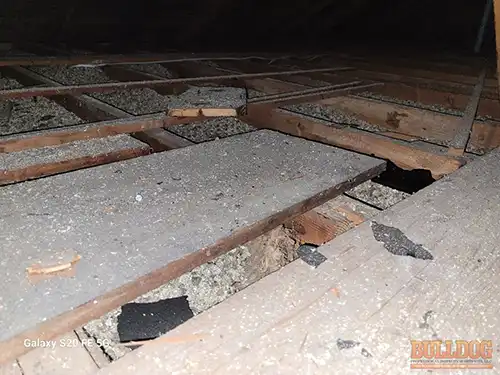
Thursday afternoon during the roof inspection of a raised ranch in the Cherokee Estates subdivision of Blue Springs, I entered the attic of a vacant 49-year-old home and found it completely filled with vermiculite insulation.
The grayish-gold, pebble-like material covered the entire attic floor between the ceiling joists. I recognized it immediately from the distinctive shiny flakes and accordion-like texture. This wasn’t just old insulation needing replacement. This was a potential asbestos hazard that would require professional testing and possibly costly removal before the buyers could move forward with any attic work.
Vermiculite insulation was widely used in homes from the 1940s through 1990, marketed as an affordable, fire-resistant attic insulation.
The problem is that over 70% of vermiculite sold in the United States came from a mine in Libby, Montana that was heavily contaminated with asbestos. When vermiculite from this mine was mined and processed, asbestos fibers became mixed throughout the material. The insulation was sold under the brand name Zonolite and installed in millions of homes, including thousands across Blue Springs and the Kansas City metro area.
The health implications are serious.
When vermiculite insulation is disturbed during renovations, attic work, or even routine storage activities, microscopic asbestos fibers become airborne and can be inhaled deep into lung tissue. These fibers cause scarring and inflammation that can lead to asbestosis, lung cancer, and mesothelioma decades after exposure.
There is no known safe level of asbestos exposure.
In Blue Springs, homes built between 1960 and 1985 frequently contain vermiculite insulation, particularly in neighborhoods developed during that construction boom when this product was actively marketed to builders.
Understanding Vermiculite Insulation: What It Is and Why It Contains Asbestos
What Is Vermiculite?
Vermiculite is a naturally occurring mineral composed of shiny flakes that resemble mica.
When heated to temperatures around 1,000 degrees Celsius, the mineral expands as much as 8-30 times its original size, creating lightweight, accordion-like strands filled with air pockets. This expanded form became popular as attic insulation because it was fire-resistant, odorless, lightweight, and easy to pour between ceiling joists.
The material could be installed quickly without specialized equipment, making it an attractive option for builders working on residential developments.
Why Vermiculite Contains Asbestos
The contamination problem traces back to geology and mining practices.
Vermiculite forms over millions of years through weathering of the mineral biotite. Unfortunately, biotite deposits often sit in close proximity to deposits of tremolite and actinolite, which are forms of asbestos. The same geological processes that create vermiculite also transform nearby minerals into asbestos fibers.
The Libby, Montana mine operated from 1919 to 1990 and supplied over 70% of all vermiculite used in the United States during that period.
The vermiculite veins at Libby ran directly through asbestos deposits, so when miners extracted the vermiculite, they inevitably pulled up asbestos along with it.
The company operating the mine, W.R. Grace, knew about the asbestos contamination but continued production and distribution for decades, exposing workers, residents of Libby, and millions of homeowners to health risks.
How Vermiculite Insulation Ages Over Time
Vermiculite insulation doesn’t degrade structurally the way fiberglass or cellulose might, but its danger increases over time as homes age.
Settling and shifting of the building structure can cause vermiculite to migrate through cracks in ceilings, around light fixtures, and into wall cavities. Temperature fluctuations and moisture in attics cause the material to expand and contract, breaking it down into finer particles that become airborne more easily.
In Blue Springs’s climate, where summer temperatures in attics can exceed 140 degrees Fahrenheit and winter brings freezing conditions, this thermal cycling accelerates the breakdown of vermiculite into smaller particles. These particles become more easily disturbed over time. The older the installation, the more friable (crumbly) the material becomes, increasing the risk of fiber release.
These are the most common questions homebuyers ask about vermiculite insulation:
What does vermiculite insulation look like?
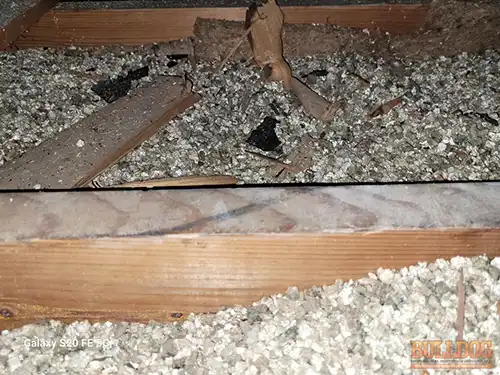
Vermiculite insulation looks like small, lightweight pebbles or flakes that are typically gray-brown, silver-gold, or light brown in color.
The material has a distinctive appearance with shiny, reflective surfaces and an accordion-like or layered texture when you look closely at individual pieces. The granules range in size from very fine particles to coarse pieces nearly an inch long, giving it an unmistakable pebble-like quality that sets it apart from other attic insulation types.
When you enter an attic containing vermiculite, you’ll see it poured loosely between ceiling joists, creating an uneven, granular surface.
The material has a lightweight, almost fluffy quality despite its rocky appearance. Many vermiculite products were sold under the brand name Zonolite, so you might find empty bags in the attic bearing that name, which confirms what you’re looking at.
The color can vary depending on the source mine and processing, but the most common vermiculite from Libby, Montana tends toward grayish-brown with metallic flecks.
In Blue Springs and across the Kansas City metro area, I find vermiculite in homes built between the 1940s and 1990s, with the heaviest use occurring during the 1960s and 1970s when this insulation was actively marketed as a fire-resistant, affordable option for attic spaces.
If you’re unsure whether your attic insulation is vermiculite, compare it to the photos on the EPA website.
Other insulation types look completely different: fiberglass is pink or yellow and comes in batts or rolls, cellulose is gray and looks like shredded newspaper, and spray foam is solid and adheres to surfaces. Vermiculite is always loose-fill, poured in place, and maintains that distinctive pebble-like appearance.
Don’t disturb the material to get a closer look. Vermiculite should be identified visually from a safe distance without touching or moving it.
Is vermiculite insulation dangerous?
Vermiculite insulation is dangerous when it contains asbestos contamination, which applies to most vermiculite installed in homes between 1919 and 1990.
The danger comes not from vermiculite itself, which is a naturally occurring mineral, but from asbestos fibers that were mixed in during the mining process. The Libby, Montana mine supplied over 70% of all vermiculite sold in the United States during this period, and that mine had natural asbestos deposits running through the vermiculite veins, contaminating virtually all material extracted from that location.
When asbestos-contaminated vermiculite is disturbed, microscopic asbestos fibers become airborne and can be inhaled deep into lung tissue.
These fibers are 1,200 times thinner than a human hair and cannot be seen with the naked eye. Once inhaled, they become permanently trapped in lung tissue, where they cause scarring and inflammation that can lead to serious respiratory diseases including asbestosis, lung cancer, and mesothelioma decades after the initial exposure.
There is no known safe level of asbestos exposure.
Even brief, one-time disturbance of vermiculite insulation can release enough fibers to create health risks. The danger increases with repeated exposure, longer duration of contact, and higher concentrations of airborne fibers.
The most dangerous scenarios include:
- Disturbing vermiculite during renovations
- Storing items in attics where vermiculite is present
- Allowing contractors to work in attics without proper asbestos protocols
- Attempting DIY removal without specialized equipment and training.
In Blue Springs homes where vermiculite has remained undisturbed above finished ceilings or isolated in sealed attics, the immediate health risk is low because the asbestos fibers stay contained within the insulation material.
However, the presence of vermiculite limits what you can do with your attic space and creates disclosure requirements when selling your home.
Any future work that might disturb the insulation requires professional asbestos abatement, not standard remodeling or insulation contractors.
How can you tell if vermiculite contains asbestos?
You can tell if vermiculite contains asbestos through professional testing by a certified asbestos laboratory, but the EPA recommends assuming all vermiculite insulation contains asbestos rather than testing it.
This recommendation exists because over 70% of vermiculite sold in the United States came from the Libby, Montana mine, which was heavily contaminated with tremolite-actinolite asbestos, and there’s no way to visually identify whether specific vermiculite came from Libby or from uncontaminated sources.
If you choose to have vermiculite tested despite EPA guidance, the process involves hiring a certified asbestos inspector who will collect multiple samples from different areas of your attic while wearing proper respiratory protection and following strict containment protocols.
The samples are sealed in special containers and sent to an accredited laboratory where technicians use polarized light microscopy or transmission electron microscopy to identify asbestos fibers.
Testing typically costs $250-$850 depending on the number of samples and analysis methods used.
The challenge with testing is that results can be unreliable.
If vermiculite is sampled from one area of the attic and tests negative for asbestos, that doesn’t guarantee the entire attic is asbestos-free because contamination levels can vary throughout the material. Additionally, the sampling process itself disturbs the insulation and releases fibers into the air, creating exposure risk during what’s supposed to be a safety assessment.
A newer testing method involves portable near-infrared spectrometers that can identify the source mine of vermiculite without collecting samples.
These handheld devices use spectral analysis to determine if vermiculite came from Libby by detecting its unique elemental signature. Home inspectors with this equipment can make determinations in moments rather than waiting days for lab results, though the devices cost tens of thousands of dollars and aren’t widely available.
In Blue Springs and throughout the Kansas City area, I recommend treating all vermiculite as asbestos-contaminated regardless of testing results. This assumption protects your family’s health and eliminates the expense and exposure risk of testing.
Should I remove vermiculite insulation or leave it alone?
You should leave vermiculite insulation alone if it’s undisturbed, contained in your attic or walls, and you have no immediate plans to renovate or work in those spaces.
The EPA recommends this approach because vermiculite poses minimal health risk when it remains sealed behind intact barriers and isn’t releasing fibers into living areas. Any disturbance of the material releases asbestos fibers into the air, so leaving it in place is often safer than attempting removal, especially if the insulation is isolated in an attic you rarely access.
However, removal becomes necessary in several situations.
- If you’re planning renovations that will disturb the insulation
- If vermiculite is spilling into living areas through ceiling cracks or light fixtures,
- If you need to improve your home’s insulation or air sealing
- If you’re preparing to sell and want to eliminate disclosure requirements and buyer concerns, professional removal is the appropriate choice.
The decision depends on your specific circumstances and timeline.
If your home already has adequate insulation levels (R-30 to R-50) and you’re not planning attic work, leaving vermiculite undisturbed makes financial and safety sense. You’ll need to limit attic access, seal any openings where insulation might fall through, avoid storing items in the attic, and prevent contractors from working in the space without proper asbestos protocols.
If you decide on removal, only use licensed asbestos abatement contractors who are trained in vermiculite-specific removal techniques.
Standard insulation contractors cannot legally remove asbestos-contaminated materials. The removal process involves sealing the work area, using negative air pressure systems, wearing respirators and protective suits, keeping the material damp during removal, double-bagging all waste, and conducting air quality testing before reopening the space.
In Blue Springs, I’ve inspected homes where vermiculite has remained safely in place for 30-40 years without issues, and I’ve seen others where removal was the only viable option due to renovation plans or visible contamination in living spaces.
There’s no one-size-fits-all answer, which is why working with an asbestos consultant helps you evaluate your specific situation.
How much does it cost to remove vermiculite insulation?
Vermiculite insulation removal costs typically range from $7,000 to $15,000 for a standard residential attic, though prices can vary from as low as $2,000 for small, accessible attics to over $30,000 for large homes with complex removal challenges.
The wide range reflects multiple cost factors including the size of the contaminated area, accessibility of the space, thickness and volume of insulation, additional materials layered on top of vermiculite, air quality testing requirements, and disposal fees for hazardous waste.
Professional removal breaks down into several expense categories:
- Asbestos testing before removal costs $250-$850 for sampling and laboratory analysis.
- Setup and containment work including sealing the work area and installing negative air pressure systems typically adds $500-$1,500 to the project.
- The actual removal labor, charged at $10 per square foot on average, makes up the largest portion of costs.
- Disposal fees for asbestos-contaminated material run $150-$400 per cubic yard depending on your location and the nearest approved disposal facility.
- Final air clearance testing and documentation costs another $400-$700 to verify the space is safe for re-occupancy.
Additional expenses can include re-insulating the attic after vermiculite removal, which costs $1.50-$3.50 per square foot depending on insulation type and R-value, and repairing any damaged drywall, ceiling penetrations, or structural elements disturbed during the removal process. If contractors discover vermiculite in wall cavities or other areas beyond the attic, costs increase proportionally.
Financial assistance is available through the Zonolite Attic Insulation Trust, which reimburses homeowners up to 55% of removal and re-insulation costs, with a maximum reimbursement of $4,633.54.
Some insurance policies cover asbestos abatement, and certain state or local programs offer assistance for low-income homeowners facing asbestos hazards.
In the Blue Springs and Kansas City metro area, removal costs tend toward the middle of the national range, with most projects falling between $8,000 and $12,000 for typical 1,200-1,500 square foot attics.
Obtaining three written estimates from licensed asbestos abatement contractors helps you identify fair pricing and avoid overcharges.
About the Author
Steve Rodriguez is a professional home inspector and the owner of Bulldog Professional Inspection Services. He performs more than 600 home inspections annually all across the KC metro area.
Based in: Raymore, MO
Service Areas: Belton, Raymore, Harrisonville, Grandview, Lee’s Summit, Blue Springs, Raytown, Independence, Liberty, Kansas City, MO, Kansas City, KS, Olathe, Leawood, Overland Park, Prairie Village, Shawnee, Lenexa
Certifications: Certified Master Inspector® (CMI). International Association of Certified Home Inspectors (InterNACHI) Certified Professional Inspector since 2004.
This article is based on a real inspection conducted in [Month YYYY – PLACEHOLDER]. The property address has been excluded for privacy. Cost estimates reflect Kansas City metro area pricing as of [Month YYYY – PLACEHOLDER] and may vary based on specific conditions and contractor selection.
Helpful Links
- Check out our GBP post about this lesson
- Recent inspections in Blue Springs, MO.
- Home inspection lessons found in other Blue Springs, MO homes
- Learn more about your roof in the Blue Springs area
Schedule Your Home Inspection
Call: (816) 564-3081
Email: info@bulldoginspect.com
Schedule Your Inspection Online