A home inspector’s findings on missing expansion tanks in Grandview homes, with installation costs and system requirements.
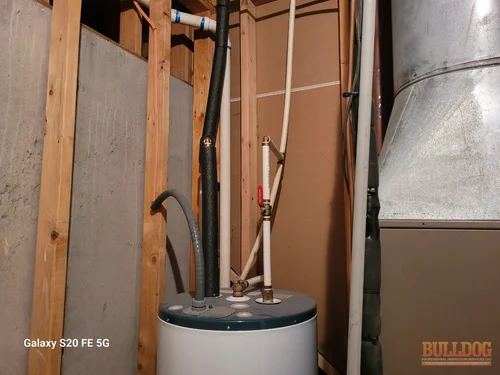
Monday morning during the plumbing inspection of a vacant 16-year-old California split-level in the Creekwood subdivision of Grandview, I found that the plumbing system had a pressure reducing valve installed, but had no expansion tank.
For Grandview homeowners, this is an issue that puts water lines at risk every time the water heater runs.
Why? Because a pressure reducing valve creates a closed-loop system.
What’s a closed loop?
Water flows into your home, but it can’t flow back out to the city supply. The pressure reducing valve (PRV) acts like a one-way gate.
That becomes a problem when your water heater heats water.
Water expands when heated so a 50-gallon water heater can generate an extra 1-2 gallons of water volume during a heating cycle.
In an open system, that expanded water can flow back into the street supply.
But with a PRV blocking that path, the expanded water has nowhere to go and pressure builds.
Without an expansion tank to absorb the extra volume, system pressure can climb from a safe 50-60 PSI to dangerous levels above 100 PSI.
That pressure stresses pipes, damages fixtures, causes relief valves to discharge, and can even damage the water heater itself.
An expansion tank prevents this by providing a cushion that absorbs thermal expansion and keeps pressure stable.
In this Grandview home, the PRV was doing its job, but without an expansion tank, every heating cycle could be creating risky pressure conditions.
Understanding Expansion Tanks in Closed Plumbing Systems
An expansion tank is a small pressurized vessel that connects to the cold water supply line near your water heater.
Inside is a rubber diaphragm that separates water from compressed air.
Here’s how it works:
- When water heats up and expands, it enters the expansion tank and pushes against the diaphragm. The compressed air behind the diaphragm provides resistance, absorbing the extra water volume and keeping system pressure stable.
- When hot water is used and temperature drops, the compressed air pushes the water back out of the tank and into the main supply.
The cycle repeats every time the water heater runs.
Why closed systems need expansion tanks:
In a closed plumbing system, water can only flow one direction: into your home. A PRV creates this condition by preventing water from flowing back to the street supply.
Backflow preventers and check valves create the same closed-loop condition.
Before these devices became standard, thermal expansion wasn’t a major issue. Expanded water simply flowed back into the municipal system.
But once a PRV or backflow preventer is installed, that escape route is blocked.
Most building codes, including those in Grandview, now mandate expansion tanks whenever a closed system exists. The requirement became widespread in the 1990s and early 2000s as PRVs and backflow preventers became more common.
The relationship between PRVs and expansion tanks:
The PRV lowers incoming street pressure to a safer level (typically from 80-120 PSI down to 50-60 PSI).
But thermal expansion happens downstream from the PRV.
When your water heater heats water, that expansion occurs on the house side of the pressure reducing valve. The PRV won’t allow the expanded water to flow back through it to relieve pressure.
That’s why the expansion tank is important: it’s the only way to control pressure increases caused by thermal expansion in a closed system.
Tank sizing:
Expansion tanks are sized based on water heater capacity and system pressure.
- Most residential systems with 40-50 gallon water heaters use a 2-gallon expansion tank.
- Larger homes with 80-gallon water heaters may need 4-5 gallon tanks.
The tank comes pre-charged with air pressure, typically 40 PSI from the factory. Before installation, the air pressure should be adjusted to match your incoming water pressure for optimal performance.
Tank construction:
Standard expansion tanks use a butyl rubber diaphragm to separate water from the air chamber. The tank shell is typically steel with a protective coating to resist corrosion. Higher-end models use stainless steel construction for longer life in areas with aggressive water chemistry.
All expansion tanks must meet NSF-61 standards for potable water contact and comply with lead-free laws.
Here are the most common questions Grandview homebuyers ask about expansion tanks:
Why is an expansion tank required when I have a pressure reducing valve?
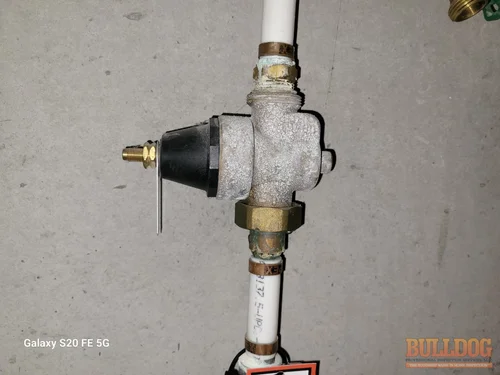
A pressure reducing valve creates a closed-loop system in your home’s plumbing.
Here’s what that means:
The PRV lowers high street pressure to a safer level for your home, but it also acts like a one-way gate. Water flows in, but it can’t flow back out to the municipal supply.
This becomes a problem when your water heater runs.
Water expands when heated. A 50-gallon water heater can generate an extra 1-2 gallons of water volume during the heating cycle.
In an open system, this expanded water flows harmlessly back into the street supply. But with a PRV blocking that path, the expanded water has nowhere to go.
That’s when pressure spikes.
Without an expansion tank to absorb the extra volume, the pressure in your plumbing system can climb from a safe 50-60 PSI to dangerous levels above 100 PSI.
But an expansion tank provides a cushion by utilizing a rubber diaphragm with compressed air behind it. When heated water expands, it enters the tank and compresses the air, keeping system pressure stable.
Can a missing expansion tank cause water hammer?
Yes, but not directly.
Water hammer is the loud banging sound you hear when water flow stops abruptly. It happens when high-pressure water slams into a closed valve.
A missing expansion tank causes a different problem first: pressure buildup.
When your water heater runs without an expansion tank in a closed system, thermal expansion drives system pressure up. Higher pressure means faster water velocity through your pipes.
That’s where water hammer comes in.
When you close a faucet or when an appliance like a dishwasher shuts off its fill valve, that high-velocity water crashes to a stop. The sudden impact creates shock waves that rattle through the pipes.
You’ll hear banging when toilets fill, washing machines shut off, or dishwashers complete their cycles.
In this Grandview inspection, the home had a PRV but no expansion tank. That combination meant every heating cycle was pushing pressure higher and increasing the risk of water hammer damage.
The expansion tank prevents this by controlling pressure. It absorbs thermal expansion before it can drive system pressure up and cause the high-velocity conditions that lead to water hammer.
Water hammer arresters installed near specific fixtures can reduce the noise, but they don’t fix the underlying pressure problem that’s caused by the missing expansion tank.
What happens if you don’t have an expansion tank in a closed system?
Pressure builds every time your water heater runs.
In a closed system created by a PRV or backflow preventer, heated water can’t escape back to the street. The expanded volume stays trapped in your plumbing system.
Here’s what that pressure does:
- Stress on pipes and fittings. Sustained high pressure can cause joints to weaken and eventually leak. You’ll see water spots on ceilings and walls from slow leaks behind drywall.
- Relief valve discharge. Your water heater’s temperature and pressure (T&P) relief valve will open to release excess pressure. You’ll see water dripping from the discharge pipe even though nothing is wrong with the heater.
- Premature fixture failure. Faucets, toilet fill valves, and washing machine hoses wear out faster under constant high pressure. Washers compress, seals fail, and you’ll replace parts more frequently.
- Water heater damage. Repeated pressure cycling can stress the tank itself. In extreme cases, the tank shell can expand or the internal flue tube can collapse.
- Surging at faucets. When you first open a faucet after the water heater has been heating, you’ll get a surge of water followed by a pressure drop as the system equalizes.
In this Grandview home, the PRV was doing its job lowering street pressure, but without an expansion tank, every heating cycle was creating these exact conditions.
Building codes typically mandate expansion tanks to prevent this damage. The tank costs $150-$450 installed, which is far less than repairing leak damage or replacing a failed water heater.
Where should an expansion tank be installed in the plumbing system?
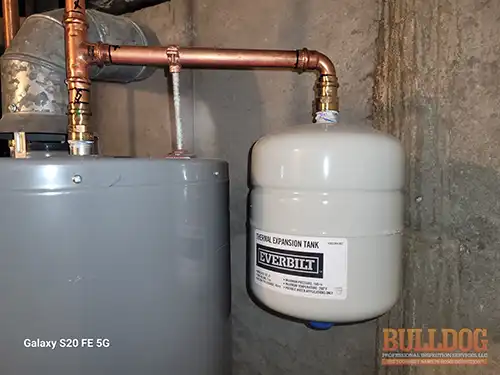
The expansion tank installs on the cold water supply line, and location matters.
- Primary location: Near the water heater on the cold water inlet pipe. This is the most common installation spot and the easiest to access for future maintenance.
- Mounting position: Vertical installation with the connection pointing down is preferred. This orientation minimizes sediment buildup inside the tank and extends its service life.
- Sequence in the system: The tank must be installed on the house side of any check valve or backflow preventer. If it’s on the wrong side, it can’t absorb thermal expansion because the check valve blocks water from reaching it.
- Relationship to T&P valve: The expansion tank should be installed before the water heater’s temperature and pressure relief valve. This allows it to control pressure before it reaches dangerous levels that would trigger the T&P valve.
In this Grandview home, there was no expansion tank installed anywhere, which meant there was no proper location to reference. The PRV was present at the water main, but the cold water line to the water heater had no tank connection point.
Installing an expansion tank needs a tee fitting in the cold water line, appropriate connectors, and proper pressure setting. The tank comes pre-charged to 40 PSI from the factory, but the air pressure should match your incoming water pressure before installation.
Most residential systems use a 2-gallon tank for homes with 40-50 gallon water heaters. Larger homes or higher-capacity water heaters may need 4-5 gallon tanks.
How much does it cost to install an expansion tank?
Installation costs depend on the tank size and labor rates in your area.
Tank cost alone: $40-$200 depending on size. A standard 2-gallon tank runs $40-$60. Larger 4-5 gallon tanks cost $140-$200.
Labor: $150-$450 for professional installation. Most plumbers charge $50-$150 per hour, and installation typically takes 2 hours.
Total installed cost: $150-$650 for most residential installations. The average homeowner pays $250-$350.
Additional costs to consider:
- Permits: $50-$100 in most jurisdictions
- Pressure gauge: $5-$10 if you don’t already own one
- Additional fittings: $20-$50 if new shutoff valves or tee fittings are needed
- Inspection fees: Usually free for the initial inspection, $25-$100 for reinspection if you miss your appointment
Factors that increase cost:
- Difficult access to the water heater area
- Need to modify existing plumbing to create space for the tank
- Higher local labor rates in urban areas or remote locations
- Larger tank requirements for commercial applications
In Grandview and the Kansas City metro area, expansion tank installation typically runs $200-$400 installed, which matches the national average.
Tank lifespan: 5-10 years on average. The rubber diaphragm eventually fails and needs replacement. Regular inspection during annual water heater maintenance can catch problems early.
For this Grandview home, installing an expansion tank would have been a straightforward job. The water heater area had clear access, and the cold water line had room for a tee fitting.
DIY installation is possible for experienced homeowners, but code compliance and proper pressure setting need careful attention. Most jurisdictions mandate a plumbing permit and post-installation inspection.
If you have a pressure reducing valve, backflow preventer, or check valve in your plumbing system, you need an expansion tank.
It’s not optional.
Without it, every heating cycle creates pressure in Grandview homes that damages pipes, wears out fixtures, and can eventually destroy your water heater.
The warning signs are easy to spot: water hammer when appliances shut off, dripping T&P relief valves, surging at faucets, and water spots on walls from slow leaks.
In this Grandview home, the PRV was present but the expansion tank was missing. That combination put the Grandview plumbing system at risk and left it vulnerable to pressure damage.
Installation costs $150-$450 and takes about 2 hours. The tank lasts 5-10 years before the diaphragm fails and needs replacement.
That’s cheap insurance compared to repairing leak damage or replacing a failed water heater.
If you’re buying a home in Grandview or anywhere in the Kansas City metro area and you see a PRV at the water main, make sure there’s an expansion tank on the cold water line near the water heater.
And if you’re selling, get it installed before the buyer’s inspector finds it missing.
About the Author
Steve Rodriguez is a professional home inspector and the owner of Bulldog Professional Inspection Services. He performs more than 600 home inspections annually all across the KC metro area.
Based in: Raymore, MO
Service Areas: Belton, Raymore, Harrisonville, Grandview, Lee’s Summit, Blue Springs, Raytown, Independence, Liberty, Kansas City, MO, Kansas City, KS, Olathe, Leawood, Overland Park, Prairie Village, Shawnee, Lenexa
Certifications: Certified Master Inspector® (CMI). International Association of Certified Home Inspectors (InterNACHI) Certified Professional Inspector since 2004.
This article is based on a real inspection conducted in December 2025. The property address has been excluded for privacy. Cost estimates reflect Kansas City metro area pricing as of December 2025 and may vary based on specific conditions and contractor selection.
Helpful Links
- Check out our GBP post about this lesson
- Recent inspections in Grandview, MO
- Home inspection lessons found in other Grandview, MO homes
- Learn more about your plumbing system in the Grandview area
Schedule Your Home Inspection
Call: (816) 564-3081
Email: info@bulldoginspect.com
Schedule Your Inspection Online