A home inspector’s guide to identifying flat roof alligator cracking in commercial buildings, with repair costs, warning signs, and replacement timelines.
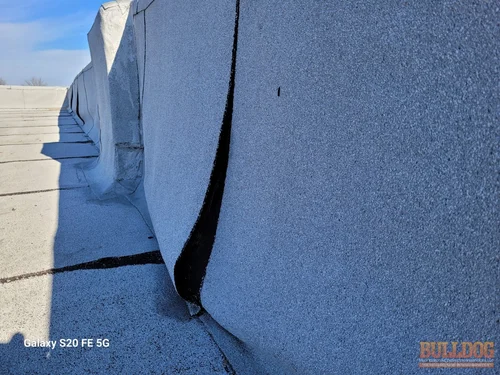
Friday morning during the roof inspection of a 121-year-old mixed-use 2-story commercial building in historic downtown Adrian, I found large open seams where the rolled roofing membrane had pulled away from the parapet walls.
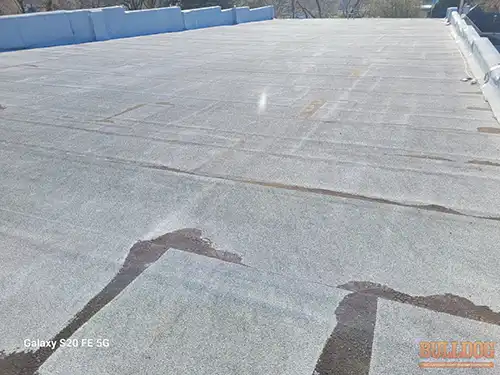
The horizontal roof surfaces showed alligator cracking across approximately 60% of the area.
The cracking pattern consisted of interconnected cracks forming 6-12 inch sections that resembled alligator skin.
This 8-year-old rolled roof was falling apart, creating multiple pathways for water infiltration into the storage area below.
In Adrian’s commercial buildings built during the early 1900s, flat roofs with parapet walls are common.
When the roofing membrane separates from vertical surfaces and the horizontal surface cracks extensively, water can bypass the weatherproofing system entirely.
The tenant buying this property needed to understand the full scope of the roofing issues before closing.
Flat rolled roofs typically last 8-12 years in Missouri’s climate, and this one was right on schedule.
Understanding Flat Roof Alligator Cracking: What It Is and Why It Fails
Flat roof alligator cracking is a pattern of interconnected surface cracks in asphaltic roofing materials that resembles alligator skin, caused by the breakdown of oils and resins in the asphalt from prolonged UV exposure and temperature cycling.
Alligator cracking occurs because UV radiation from the sun dries out the asphaltic compounds that give rolled roofing its waterproofing properties, causing these materials to become brittle.
As the roof expands and contracts with temperature changes, the rigid surface splits into a network of cracks that start small but grow wider and deeper over time.
Home inspectors following InterNACHI’s Standards of Practice identify alligator cracking as a defect requiring correction when it compromises the roof’s weatherproofing function.
The process begins with surface oxidation that turns the black roofing material gray or silver.
As oxidation penetrates deeper into the material, the asphalt becomes increasingly brittle.
Temperature cycling accelerates this deterioration.
During hot Adrian summer days, the roof surface can reach 110-120°F, causing the material to expand.
At night, temperatures drop 70-80 degrees, causing contraction.
This constant expansion and contraction creates stress in brittle asphalt that has lost its elasticity.
Cracks form perpendicular to areas of stress, creating the characteristic alligator pattern.
In Adrian’s climate, with intense summer sun and significant temperature swings, rolled roofing deteriorates faster than in milder climates.
The progression follows a predictable timeline.
Years 1-3 show minimal damage, with slight color fading and minor surface cracks appearing.
Years 4-6 bring noticeable alligator patterns forming in high-exposure areas, particularly on horizontal surfaces receiving direct sunlight.
Years 7-9 see crack networks expanding and deepening, with some cracks penetrating through to the underlayment.
Years 10-12 mark critical failure, where widespread cracking allows water infiltration and the roof requires complete replacement rather than repair.
The 8-year-old roof I inspected in Adrian had reached the stage where maintenance was long overdue.
Here are the most common questions homebuyers ask about flat roof alligator cracking:
What causes alligatoring on a flat roof?
Alligatoring on a flat roof happens when UV exposure dries out the asphaltic materials in rolled roofing or built-up systems, causing the surface to crack in patterns that look like alligator skin.
The sun’s ultraviolet rays break down the oils and resins that keep the asphalt flexible, making it brittle over time.
The primary cause is oxidation of the asphaltic compounds.
When asphalt roofing is first installed, it contains oils that give it flexibility and waterproofing properties.
UV radiation from sunlight causes a chemical reaction that evaporates these oils, leaving behind brittle, dried-out material.
You can see this process visually as the roof changes color from black to gray or silver.
Temperature cycling only makes it worse.
During the day, your flat roof absorbs heat and expands. At night, it cools and contracts.
This daily expansion and contraction creates mechanical stress throughout the roofing material.
When the asphalt is flexible, it handles this stress without damage.
But once UV exposure has made it brittle, the material can’t flex anymore, so it cracks instead.
In Adrian’s climate, these temperature swings are significant.
Summer days can heat your roof surface to 110-120°F, while nighttime temperatures drop to 70-80°F.
That 80-100 degree daily temperature range puts enormous stress on aging roof materials.
Over years of this cycling, small surface cracks expand into the interconnected network that gives alligator cracking its name.
Poor drainage accelerates alligator cracking.
When water pools on your flat roof, it sits on the surface for extended periods, breaking down the asphalt faster than water that drains immediately.
The standing water also creates temperature differentials, with the wet areas staying cooler than dry areas during the day.
This uneven heating and cooling creates additional stress points where cracks form.
Inadequate roof maintenance speeds up the timeline.
Flat roofs need regular inspections and minor repairs to extend their life.
When small cracks and surface damage go unaddressed for years, UV penetration accelerates and the deterioration spreads faster than it would with proper maintenance.
Can alligatoring be repaired or does the roof need to be replaced?
Alligatoring can be repaired if it covers less than 25% of your roof’s surface area and the cracks haven’t penetrated through to the underlayment.
In these cases, you can apply an elastomeric coating or roof sealant to seal the cracks and extend the roof’s life by 2-3 years.
The repair involves thoroughly cleaning the affected area, filling deep cracks with patching compound, and applying a thick coating of elastomeric material that forms a new waterproof membrane over the damaged surface.
This approach works because the coating creates a flexible barrier that prevents water infiltration while protecting the underlying asphalt from further UV damage.
When alligator cracking covers 25-50% of your roof, you’re in a gray area where repair becomes questionable.
The coating will still seal the surface, but you’re dealing with a roof that has deteriorated significantly throughout its entire thickness.
Even if you seal the visible cracks, the underlying material continues breaking down.
You might get 1-2 years of additional service, but you’re essentially buying time rather than solving the fundamental problem.
At this level of damage, you need to factor in whether spending $2-4 per square foot on coating makes financial sense when the roof will need complete replacement soon anyway.
When alligator cracking exceeds 50% of your roof surface, or when cracks have penetrated through to the underlayment, replacement is your only viable option.
At this stage, the roofing material has failed structurally.
No amount of coating will restore its waterproofing integrity because water has already found pathways through the membrane.
Attempting to repair a roof this damaged wastes money on a temporary fix that won’t prevent leaks or protect your building.
The Adrian building I inspected had alligator cracking covering approximately 60% of the horizontal surfaces.
Multiple cracks had opened enough to expose the underlayment.
Here’s the cost breakdown for repair versus replacement in Adrian commercial buildings:
- Elastomeric coating runs $2-4 per square foot, so a 2,000 square foot roof costs $4,000-8,000 to coat.
- Complete tear-off and replacement with new rolled roofing costs $4-7 per square foot, or $8,000-14,000 for the same roof.
When your existing roof has 40-50% alligator cracking, spending $6,000 on coating to get 1-2 additional years doesn’t make sense compared to spending $11,000 for a new roof that lasts 10-12 years.
What are open seams at parapet walls and why do they leak?

Open seams at parapet walls happen when the roofing membrane pulls away from the vertical wall where it transitions from the horizontal roof surface.
This creates a gap where water can enter the building, bypassing your roof’s weatherproofing system entirely.
The seam opens because the roofing material is fighting two different forces at this critical transition point.
Parapet walls are the short vertical walls that extend above your flat roof line around the building’s perimeter.
Your roofing membrane must make a 90-degree turn from the horizontal roof deck up the vertical wall face.
This transition point experiences the highest stress of any location on your roof.
During installation, roofers use various methods to secure the membrane at this transition, including mechanical fasteners, adhesive, and sometimes metal flashing.
But over time, thermal movement creates forces that work against these attachment methods.
Thermal movement causes open seams because flat roofs expand and contract significantly with temperature changes.
On a hot summer day in Adrian, your roof surface can expand several inches across its width as the material heats up.
At night, it contracts back as it cools.
The horizontal membrane wants to move with these temperature changes, but the vertical parapet wall doesn’t move at the same rate because it’s shaded and doesn’t experience the same temperature extremes.
This differential movement creates pulling forces at the transition point.
Year after year of this pulling gradually weakens the adhesive bond or works fasteners loose.
Eventually, the membrane separates from the wall, creating an open seam.
Poor installation makes open seams inevitable.
Many roofing contractors don’t install cant strips at the transition from horizontal to vertical surfaces.
Cant strips are triangular pieces of wood or rigid insulation that create a gradual slope instead of a sharp 90-degree angle.
This reduces stress on the membrane and creates a more secure attachment point.
When installers skip cant strips to save time or money, they create a weak point that will fail prematurely.
The rolled roofing also needs proper overlap and adhesion at the parapet wall.
If installers don’t extend the membrane high enough up the wall, or if they don’t apply adequate adhesive, the seam starts out weak and deteriorates quickly.
Open seams leak because water flowing across your flat roof during rain naturally migrates to the lowest points and edges.
When the membrane has pulled away from the parapet wall, water flows directly into that gap.
It runs down between the membrane and the wall, bypassing all your weatherproofing layers.
From there, it can enter the building through any crack or joint in the parapet wall construction.
The building I inspected in Adrian had open seams measuring 2-4 inches wide at multiple locations around the parapet walls.
Water flowing into these gaps would travel down the interior face of the parapet wall and enter the building at the roof deck level, causing ceiling damage and potential structural issues in the wall framing.
How long does a flat rolled roof last before it needs replacement?
A flat rolled roof typically lasts 8-12 years before needing replacement, though this varies based on climate, installation quality, and maintenance.
In Adrian’s climate, with hot summers and significant temperature swings, expect your rolled roof to reach the end of its useful life closer to 8-10 years.
The material composition determines the baseline lifespan.
Rolled roofing (also called roll roofing or mineral surface roll) consists of a fiberglass or organic felt mat saturated with asphalt and coated with mineral granules on the surface.
This construction is lighter and less expensive than built-up roofing or modified bitumen systems, but it also has a shorter service life.
The asphalt that waterproofs the roof breaks down from UV exposure over time.
The mineral granules that protect the asphalt from direct sunlight gradually wear away from foot traffic, wind, and weather.
Once the granules are gone, UV radiation attacks the asphalt directly, accelerating deterioration.
Climate impact is significant for rolled roofing lifespan.
In mild coastal climates with moderate temperatures and minimal sun exposure, rolled roofing can last toward the upper end of the 8-12 year range.
In hot, sunny climates like Adrian, Missouri, where summer temperatures regularly exceed 90°F and the sun beats down on your roof for 12-14 hours per day during peak season, you’ll see lifespan closer to 8-10 years.
Temperature cycling matters as much as heat itself.
Missouri experiences four distinct seasons with temperature swings of 100+ degrees from summer highs to winter lows.
This constant expansion and contraction stresses the roofing material more than in climates where temperatures stay relatively stable year-round.
Installation quality affects how long your roof lasts.
A properly installed rolled roof includes adequate overlap at seams, proper fastening at all edges and penetrations, and correct flashing at transitions to vertical surfaces.
Poor installation shortcuts this timeline.
If your roofer didn’t overlap seams adequately, used insufficient fasteners, or skipped flashing details, your roof might fail in 5-7 years instead of 8-10.
The 8-year-old rolled roof I inspected in Adrian showed typical deterioration, suggesting inadequate maintenance.
Maintenance extends service life.
Flat roofs need annual inspections to identify and repair minor damage before it becomes major.
Cleaning drains and removing debris prevents standing water that accelerates deterioration.
Applying roof coating at year 6-7 can add 2-3 years of life by protecting the aging asphalt from further UV damage.
Commercial buildings that invest $500-800 annually in preventive maintenance often get 10-12 years from rolled roofing.
Buildings that skip maintenance entirely might only get 6-8 years.
When your rolled roof reaches 8-10 years old, start planning for replacement even if you don’t see obvious damage yet.
Waiting until you have active leaks often means you’ve already sustained interior damage that costs more to repair than proactive roof replacement would have cost.
How much does commercial flat roof replacement cost?
Commercial flat roof replacement costs $4-11 per square foot depending on the roofing material you choose, the building’s size, and accessibility.
For a typical small commercial building like the one in Adrian (approximately 2,000-3,000 square feet), expect to pay $15,000-35,000 for a complete tear-off and replacement.
The cost breakdown starts with the existing roof removal.
Tearing off old rolled roofing runs $1-2 per square foot, or $2,000-6,000 for a 2,000-3,000 square foot roof.
This includes labor to remove the old membrane, haul away debris, and dispose of materials at the landfill.
If your existing roof has multiple layers that need removal, or if it contains asbestos that requires special handling, tear-off costs increase to $3-4 per square foot.
Material costs vary significantly by roofing system type.
- Rolled roofing (mineral surface roll) is the most economical option at $0.50-1.50 per square foot for materials alone.
- Modified bitumen runs $1.50-3 per square foot.
- EPDM rubber membrane costs $1.50-2.50 per square foot.
- TPO single-ply membrane runs $1.75-3 per square foot.
- Built-up roofing (BUR) with multiple plies costs $2.50-4 per square foot for materials.
These material costs don’t include installation labor, which typically equals or exceeds material cost.
Installation labor also depends on roof complexity.
Simple rectangular roofs with few penetrations cost less per square foot because roofers can work efficiently.
Roofs with multiple HVAC units, vents, skylights, and parapet walls require more cutting, fitting, and flashing work, increasing labor costs.
- A complete flat roof replacement for this building including tear-off ($2,000-4,000)
- New rolled roofing or modified bitumen membrane ($3,000-9,000 for materials)
- Installation labor ($6,000-12,000)
- New flashing at parapet walls and penetrations ($2,000-4,000)
- Disposal fees ($500-1,000)
- Permits ($200-500).
Total estimated cost: $13,500-30,500, which I rounded to $15,000-35,000 to account for variables.
Material upgrades change the equation.
If the building owner in Adrian chose rolled roofing again, the replacement would cost toward the lower end ($15,000-20,000).
Upgrading to modified bitumen or TPO would cost $22,000-30,000.
Choosing a built-up roofing system would push costs to $28,000-35,000.
The upgraded materials last 15-20 years instead of 8-12 years, so the higher upfront cost spreads over a longer service life.
Building size also affects per-square-foot pricing.
Larger roofs benefit from economies of scale because setup costs (equipment rental, permits, project management) spread across more square footage.
- A 5,000-10,000 square foot commercial roof might cost $3.50-8 per square foot installed.
- Very small roofs under 1,000 square feet often cost $7-12 per square foot because minimum charges apply.
Accessibility impacts labor costs.
Single-story buildings with easy roof access cost less than multi-story buildings where roofers must use scaffolding or lifts.
Buildings with adequate parking for dumpsters and material staging cost less than downtown buildings where street access is limited.
The Adrian building’s downtown location with limited staging area would push costs toward the middle to upper end of the range.
Timing matters for commercial roof replacement.
Scheduling work during slow season (late fall or early spring) often yields 10-15% discounts from contractors looking to fill their schedule.
Summer is peak season when contractors are booked solid and pricing is highest.
Emergency replacements after leak damage cost 20-30% more than planned replacements because you have no negotiating leverage and contractors charge premium rates for rush work.
Flat roof alligator cracking in Adrian commercial buildings isn’t an isolated problem.
It’s a common issue in buildings over 75 years old where rolled roofing systems have reached the end of their 8-12 year service life.
Understanding the warning signs helps commercial property buyers and investors make informed decisions before closing on a purchase.
The visible deterioration tells you whether you’re dealing with a repair situation or a complete replacement situation.
Proactive roof replacement costs $15,000-35,000 for small commercial buildings, while emergency repairs after water damage costs significantly more when you factor in interior ceiling repairs, inventory damage, and business disruption.
About the Author
Steve Rodriguez is a professional home inspector and the owner of Bulldog Professional Inspection Services. He performs more than 600 home inspections annually all across the KC metro area.
Based in: Raymore, MO
Service Areas: Belton, Raymore, Harrisonville, Grandview, Lee’s Summit, Blue Springs, Raytown, Independence, Liberty, Kansas City, MO, Kansas City, KS, Olathe, Leawood, Overland Park, Prairie Village, Shawnee, Lenexa
Certifications: Certified Master Inspector® (CMI). International Association of Certified Home Inspectors (InterNACHI) Certified Professional Inspector since 2004. This article is based on a real inspection conducted in December 2025. The property address has been excluded for privacy. Cost estimates reflect Kansas City metro area pricing as of December 2025 and may vary based on specific conditions and contractor selection.
Helpful Links
- Recent inspections around Adrian, MO.
- Home inspection lessons found in homes around Adrian, MO.
- Learn about roofs types around Adrian, MO.
Schedule Your Home Inspection
Call: (816) 564-3081
Email: info@bulldoginspect.com
Schedule Your Inspection Online