







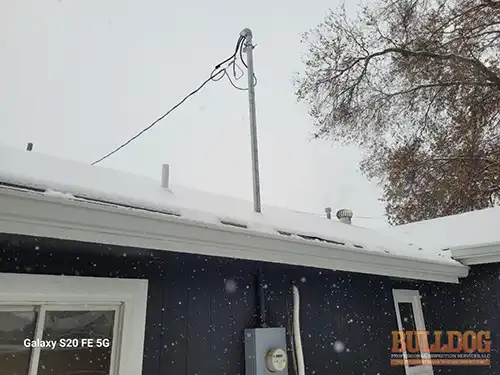
Yesterday morning during the electrical inspection of a vacant 52-year-old ranch-style home in Spring Hill, KS, I discovered a 5-foot service mast sticking up above the roof with no guy wire attached.
The mast was bent from the sheer weight of the service lines, ice, snow, and tree branches, but it wasn’t causing any immediate damage at the time of inspection.
A guy wire is an easy but important fix that maintains safe and reliable electrical service to a home.
In Spring Hill’s aging housing stock, I find unsupported service masts in approximately 20% of homes over 40 years old where the original installation didn’t account for the lateral forces from overhead service drops.
This isn’t a cosmetic issue.
It’s a structural electrical safety concern that affects power reliability and can lead to expensive emergency repairs if ignored.
Understanding Service Mast Guy Wires: What They Are and Why They Fail
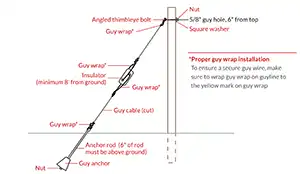
A service mast guy wire is a galvanized steel cable that anchors the electrical service mast to the roof structure to prevent bending from the weight and tension of overhead power lines.
The mast itself is the vertical metal conduit that brings electricity from the utility pole to your meter and main panel.
When the mast extends more than 24 to 36 inches above the roofline, the lateral forces from the service drop conductors create enough stress to bend the conduit over time.
Service masts fail to have guy wires for several reasons.
In homes built before utility companies established strict height requirements, many installations were completed without support cables because the standards didn’t exist yet.
Some electricians cut corners during installation to save time and materials, especially on projects where inspections weren’t thorough.
In other cases, guy wires were installed originally but removed during roof replacements when roofers didn’t understand their purpose or didn’t want to work around them.
Kansas and Missouri weather accelerates the problem.
Our region experiences heavy ice storms that add significant weight to overhead power lines, increasing the lateral pull on service masts.
Spring winds create dynamic loading as the service drop sways, causing repeated stress cycles that fatigue the metal conduit.
Summer storms bring tree branches down onto service lines, adding sudden shock loads that can bend even properly supported masts.
The progression from unsupported to failed happens gradually.
Initially, the mast may show only a slight lean that’s barely noticeable from ground level.
Over months or years, the bend becomes more pronounced as the metal fatigues and loses its structural integrity.
Eventually, the mast can no longer support the electrical connections properly, creating safety hazards and potential power interruptions.
How to Identify Missing Guy Wires on Your Service Mast: 6 Warning Signs
You don’t need to be a home inspector to spot the warning signs of an unsupported service mast.
Here’s what to watch for in ranch-style and split-level homes, especially those built before 1990:
- Visible lean or bend in the mast when viewed from ground level. Stand back from your house and look at the service mast where it extends above the roofline. If it appears to lean toward the utility pole or shows any curvature instead of standing perfectly vertical, it’s under excessive stress from the service drop.
- Mast height exceeds 36 inches above the roofline without visible support cables. Use a tape measure or estimate the height by comparing it to standard roof features. Most utility companies require guy wires for any mast extending more than 24 to 36 inches, though the exact threshold varies by power company.
- Gaps or separation between the weatherhead and the top of the conduit. Look at the connection point where the service drop wires enter the weatherhead cap. If you see daylight through gaps or notice the weatherhead isn’t sitting flush against the conduit, the mast has moved from its original position.
- Rust stains or water damage on the roof around the mast penetration. A bending mast creates stress at the roof boot seal, causing cracks that allow water infiltration. Brown or rust-colored staining on shingles near the mast base indicates the seal has failed.
- Loose or damaged service drop connections at the weatherhead. If the overhead wires appear to be pulling at an angle or show slack where they should be taut, the mast position has shifted enough to affect the electrical connections.
- Previous roof repairs that removed or damaged support hardware. Check the roof surface around the mast for patched areas, replaced shingles, or signs of removed mounting brackets. Roofers sometimes remove guy wires during re-roofing and fail to reinstall them properly.
The best place to check is from multiple viewing angles around your property.
Walk the perimeter of your home and observe the mast from each side to detect even slight bends that might not be visible from a single position.
If you can safely access the roof, look for anchor points where guy wires should attach to the roof structure, typically located 4 to 8 feet from the mast base.
If your mast shows any of these warning signs, contact a licensed electrician for a professional evaluation.
Don’t wait for the mast to bend further or fail completely during the next ice storm.
Proactive guy wire installation costs a fraction of emergency mast replacement and prevents the power outages and safety hazards that come with complete structural failure.
What I Found in Spring Hill: A Case Study
During my December 1, 2025 inspection of a 52-year-old ranch in Spring Hill, I documented what I consider a typical example of the long-term effects of an unsupported service mast in Kansas weather conditions.
The home had been vacant for several months after the previous owner moved to assisted living.
The family was selling it as-is, and the buyers—a young couple making their first home purchase—had wisely included a full inspection with electrical evaluation in their contract.
When I arrived and began my exterior inspection, the bent service mast was immediately visible from the street.
The 2-inch rigid metal conduit extended approximately 5 feet above the roofline, well beyond the 24-inch threshold where Evergy (the local utility company) requires guy wire support.
The mast showed a pronounced lean toward the utility pole, creating about a 10-degree angle from vertical.
I photographed the mast from multiple angles and measured the height from the roof surface to the weatherhead at 60 inches.
The bend appeared to be concentrated in the unsupported section above the roof, which is typical because that’s where the conduit has no structural reinforcement from the building.
From the roof level, I could see stress marks where the conduit flexed repeatedly from wind loading and ice accumulation.
The roof boot around the mast penetration showed minor cracking but no active water infiltration at the time of inspection.
However, the seal had clearly been compromised by the mast movement, creating a future leak risk that would need addressing during the guy wire installation.
The weatherhead connections appeared sound, with no visible gaps or loose wire attachments.
This indicated the bending had occurred gradually rather than from a single catastrophic event like a fallen tree branch.
The buyers asked if the mast needed immediate replacement or if guy wire installation would be sufficient.
I explained that in this case, the conduit could likely be straightened and properly supported without full replacement, saving several hundred dollars in repair costs compared to emergency mast replacement scenarios.
The Financial Reality of Service Mast Guy Wire Installation: What Repairs Actually Cost
Cost Breakdown
Installing guy wires on an existing service mast in the Spring Hill and Kansas City area typically costs between $200 and $500 depending on the mast height, roof structure, and whether additional repairs are needed.
Here’s what affects the price:
Simple guy wire installation runs $200-$300 and includes the guy wire kit, roof mounting hardware, labor to locate and anchor to roof rafters, and weatherproofing of all penetrations.
This applies when the mast is only slightly bent and can be straightened by the electrician during installation.
Moderate repairs cost $350-$450 when the mast requires significant straightening, the roof boot needs replacement, or the roof structure requires additional blocking between rafters to provide adequate anchor points.
This level includes all materials and labor for a complete installation that meets utility company standards.
Major corrections run $500-$800 when the mast has developed metal fatigue requiring conduit replacement, the weatherhead is damaged and needs replacement, or the meter socket connections have been stressed and need evaluation.
At this level, you’re essentially rebuilding the upper service entrance while adding proper support.
Spring Hill-specific costs include electrical permits ($50-$100 from Johnson County), utility coordination if Evergy needs to temporarily disconnect service ($0-$75), and potential roof repairs if the existing boot penetration has caused water damage ($100-$300).
Timeline for installation ranges from 2-4 hours for straightforward guy wire addition to a full day for comprehensive mast repair with boot replacement and structural reinforcement.
What Happens If You Ignore It
Months 1-6: The mast continues to bend under constant lateral pressure.
You might not notice any immediate problems, but the metal is fatiguing with each wind gust and ice accumulation cycle.
The roof boot seal develops micro-cracks that allow minimal water infiltration during heavy rains.
Cost to repair at this stage: still $200-$300 for guy wire installation before significant damage occurs.
Months 6-24: The bend becomes visible from ground level.
The weatherhead connections begin to stress as the angle between the service drop and the mast increases beyond design specifications.
Water infiltration through the compromised roof boot causes moisture damage to roof sheathing, requiring repairs when the mast is eventually supported.
The electrical connections may develop increased resistance from movement, creating potential fire hazards.
Cost to repair: $450-$700 because you’re now fixing secondary water damage and potentially replacing the weatherhead and roof boot in addition to installing guy wires.
Years 2+: The mast fails completely during an ice storm or high wind event, typically when additional weight or lateral force exceeds the fatigued metal’s structural capacity.
You lose power to the home, require emergency electrician service at premium rates, face potential damage to the meter socket and service panel from the mast collapse, and need utility company re-inspection before power can be restored.
The repair becomes priority emergency work rather than scheduled maintenance.
Cost to repair: $1,500-$3,000 for complete mast replacement, meter socket evaluation, emergency service premiums, expedited permits, and utility company reconnection fees.
The buyers in this Spring Hill home are purchasing as-is, which means they’ll handle the guy wire installation after closing rather than negotiating a credit during the transaction.
They’re budgeting $400 for the work based on quotes from local electricians, planning to complete it within the first month of ownership before winter weather adds ice loading to the unsupported mast.
Why This Matters in Spring Hill
Spring Hill’s housing stock includes hundreds of ranch-style and split-level homes built between 1960 and 1985 with electrical service masts that predate modern utility company guy wire requirements.
During this construction era, Evergy (then Kansas Power and Light) didn’t enforce strict height limits or mandatory support requirements for residential service masts.
Many homes were built with tall masts to achieve adequate clearance over additions, garages, or landscaping features without anyone considering the long-term structural implications.
Our regional weather patterns make unsupported masts particularly vulnerable.
Spring Hill experiences an average of 2-3 significant ice storms per winter, with ice accumulation on power lines ranging from half an inch to over an inch in severe events.
This ice loading can triple the weight on service drop conductors, dramatically increasing the lateral pull on service masts.
Spring winds averaging 15-25 mph with gusts to 40 mph create constant dynamic loading that fatigues metal conduit through repeated stress cycles.
Summer thunderstorms bring tree branches down onto service lines, adding sudden shock loads that can permanently bend even relatively new installations.
Johnson County’s building inspection practices have tightened significantly over the past two decades.
New construction and major electrical service upgrades now require guy wires on any mast exceeding 24 inches above the roofline, bringing local standards in line with Evergy’s published requirements.
However, existing installations in older homes remain grandfathered under previous codes until the service is upgraded or the homeowner voluntarily brings it up to current standards.
In areas built during Spring Hill’s rapid growth period of the 1970s and early 1980s, I consistently see service mast issues in homes where the original installation prioritized minimal cost over long-term reliability.
These homes are now 40-55 years old, and the service masts that seemed adequate when new are showing stress from four decades of Kansas weather exposure.
The pattern is predictable: homes built before 1985 with masts extending more than 36 inches above the roofline almost always need guy wire support added, either proactively by informed homeowners or reactively after the mast begins to fail.
What You Should Do
For Homebuyers
If you’re buying a home in Spring Hill built before 1990, add electrical service mast evaluation to your inspection checklist:
During your walkthrough, look up at the roofline from multiple angles to check if the service mast appears straight or shows any lean toward the utility pole.
Estimate or measure the mast height above the roof surface—anything over 24 inches should have guy wire support.
Ask your inspector these specific questions: “Can you check the service mast for proper support?” “Does the mast height exceed Evergy’s requirements for guy wires?” “Do you see any signs of stress at the roof penetration or weatherhead connections?”
Don’t assume your inspector will evaluate the mast thoroughly without specific direction.
If your inspector finds an unsupported mast, get quotes from two licensed electricians before negotiating with the seller.
Costs for guy wire installation range from $200 to $500 depending on the mast condition and required repairs.
Use the lower quote to negotiate a credit at closing or request the work be completed before closing if the mast shows significant bending.
Walk away if the seller refuses to address a severely bent or failed mast and you’re not prepared to handle emergency electrical repairs immediately after moving in.
This isn’t a cosmetic issue you can defer—it’s a safety concern that affects power reliability and can create additional structural damage if ignored.
For Homeowners
If you own a ranch or split-level home built before 1990 in Spring Hill, inspect your service mast annually for signs of stress or bending:
Stand back from your house and observe the mast from the street and both side yards to detect any lean or curvature.
Measure the height from the roof surface to the weatherhead—if it exceeds 36 inches and you don’t see guy wires, you need them.
Check the roof boot around the mast base for cracks, gaps, or water staining that indicates the seal has been compromised by mast movement.
Schedule a professional electrical evaluation if your mast shows any warning signs or if you’ve recently had roof work done that may have removed original support hardware.
Budget $300-$400 for guy wire installation on a straight mast in good condition, or $500-$800 if the mast needs straightening and the roof boot needs replacement.
The work typically takes half a day and prevents the $1,500-$3,000 cost of emergency mast replacement during a winter storm.
Install the guy wires before the next ice storm season rather than waiting for damage to occur.
Proactive maintenance costs a fraction of reactive emergency repairs, and it protects your home’s electrical system from the stress and potential fire hazards created by loose connections in a failing mast.
For Sellers
If you’re selling a home with a tall service mast, a pre-listing electrical evaluation can reveal guy wire issues before buyers find them:
Have the mast inspected by a licensed electrician who can provide documentation of its condition and any needed repairs.
If guy wires are missing or the mast shows bending, decide whether to fix it before listing or disclose it and adjust your asking price accordingly.
Installing guy wires before listing demonstrates that you’ve maintained the home properly and removes a negotiation issue that could delay closing or reduce buyer confidence in the overall property condition.
If you can’t afford the repair before listing, disclose the issue in your seller’s disclosure statement and price the home to account for the $300-$500 repair cost buyers will face.
Transparency about electrical issues prevents last-minute negotiation surprises and reduces the risk of buyers walking away after their inspection reveals problems you didn’t disclose.
Homes with documented recent electrical maintenance and proper service mast support sell faster and for higher prices than comparable homes with deferred electrical maintenance that buyers view as potential safety hazards.
What Happened Next: The Resolution
The buyers in this Spring Hill home made an informed decision based on the inspection findings and their post-closing budget.
After receiving my inspection report documenting the unsupported 5-foot service mast with visible bending, they acknowledged the issue but elected to proceed with the purchase in as-is condition rather than negotiating a credit or requesting repairs before closing.
They obtained quotes from two licensed electricians during their inspection period, receiving estimates of $375 and $425 for guy wire installation including mast straightening, roof penetration sealing, and coordination with Evergy if temporary disconnection was needed.
The buyers are planning to schedule the electrical work within their first 30 days of ownership, before winter weather adds ice loading to the already-stressed mast.
They’re using the lower quote of $375 as their budget and have already contacted the electrician to discuss scheduling once they close on the property.
This approach allows them to move forward with their purchase while addressing the electrical safety concern on their timeline rather than as a closing contingency that could delay their move-in date.
The Bigger Picture
Service mast guy wire issues in Spring Hill homes aren’t isolated incidents—they’re predictable maintenance needs that emerge when 40-50 year-old electrical installations meet modern utility company standards and decades of Kansas weather exposure.
I’ve inspected over 600 homes in the Kansas City metro in the past year, and I find unsupported service masts exceeding recommended heights in approximately 20% of homes built between 1960 and 1985.
This isn’t a defect in the original construction—it’s the result of codes and utility requirements evolving over time to address long-term reliability concerns that weren’t fully understood when these homes were built.
As Spring Hill’s housing stock continues to age, the percentage of homes needing guy wire installation will only increase.
By 2030, nearly every ranch and split-level home built before 1985 will be 45+ years old, and the service masts that seemed adequate when installed will show stress from four to five decades of weather exposure, repeated ice storms, and metal fatigue.
Understanding this pattern helps buyers negotiate fairly during home purchases.
It helps sellers prepare homes realistically for listing by addressing known electrical maintenance before buyers discover it during inspections.
And it helps homeowners plan for predictable maintenance before an unsupported mast bends severely enough to require emergency repairs during a winter storm.
The good news: service mast guy wire installation is straightforward, affordable, and preventive.
Armed with the right information and a qualified electrician, you can address this issue proactively for $300-$500 rather than waiting for emergency replacement that costs $1,500-$3,000.
Knowledge removes uncertainty, and when it comes to electrical safety and power reliability, certainty is worth every dollar invested in proper support.
About the Author
Steve Rodriguez is a Certified Master Inspector® and performs over 600 home and property inspections annually all across the KC metro area.
Based in: Raymore, MO.
Service Areas: Belton, Raymore, Harrisonville, Grandview, Lee’s Summit, Blue Springs, Raytown, Independence, Liberty, Kansas City, MO, Kansas City, KS, Olathe, Leawood, Overland Park, Prairie Village, Shawnee, Lenexa
Certifications: Certified Master Inspector® (CMI). International Association of Certified Home Inspectors (InterNACHI) Certified Professional Inspector since 2004.
This article is based on a real inspection conducted in December 2025. The property address has been excluded for privacy. Cost estimates reflect Kansas City metro area pricing as of December 2025 and may vary based on specific conditions and contractor selection.
Helpful Links
- Check out our GBP post about this lesson
- Learn more about our electrical inspection process
- Recent inspections in Spring Hill, KS
- Home inspection lessons found in other Kansas City area homes
Schedule Your Home Inspection
Call: (816) 522-0001
Email: info@bulldoginspect.com
Schedule Your Inspection Online