

A home inspector‘s guide to identifying and understanding rusted water heaters in Polo homes, with costs, warning signs, and replacement timelines.
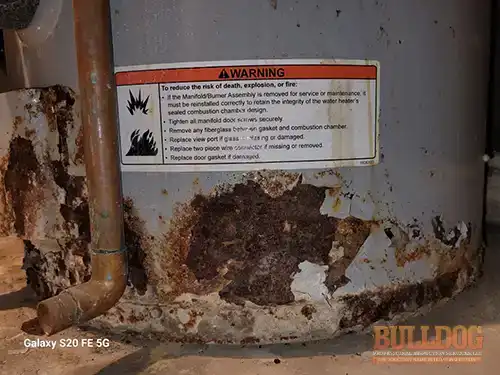
Tuesday afternoon during the plumbing inspection of a vacant 25-year-old reverse 1.5-story home just off SW State Rte T and SW Longhorn Dr in Polo, MO, I found an 8-year-old water heater that looked more like it was 25 years old.
The tank exterior showed heavy rust scaling across the bottom third.
Water heaters typically last 10-12 years with proper maintenance, but this unit had deteriorated to the point where replacement would be necessary soon, even though it wasn’t actively leaking yet.
The extensive rust told the story of hard well water taking its toll on metal components faster than normal.
In rural Polo, most homes rely on private wells rather than municipal water systems.
Well water in Caldwell County often contains elevated iron levels and minerals that accelerate corrosion in water heaters.
This 8-year-old tank showed rust patterns I typically see in units twice its age.
While not leaking during my inspection, the deterioration meant this water heater was living on borrowed time.
Once rust progresses this far, the protective layers inside the tank have failed, and it’s only a matter of months before small leaks develop into major failures.
In Polo’s housing stock—where many homes are 20-50 years old with original or aging plumbing systems—rusted water heaters represent one of the most common issues I find during inspections.
I document some level of water heater rust or corrosion in approximately 30% of rural Missouri home inspections.
Understanding what causes rust, how to identify it early, and what replacement costs to expect helps homebuyers make informed decisions about properties in Polo and surrounding communities.
Understanding Water Heater Rust: What It Is and Why It Fails
Water heater rust is the corrosion of metal components that occurs when protective barriers break down and allow water to contact bare steel, causing oxidation that weakens the tank structure and eventually leads to leaks or complete failure.
Water heaters are designed with multiple rust-prevention systems because they constantly hold 40-50 gallons of water at 120-140°F.
The tank interior has a thin glass lining that prevents water from touching the steel walls.
Running vertically through the center is a sacrificial anode rod—a steel core wrapped in magnesium, aluminum, or zinc—that attracts corrosive elements away from the tank itself.
These defenses work well for 8-12 years under normal conditions.
However, rural Polo’s well water creates harsher conditions than municipal water systems.
High mineral content—particularly iron, calcium, and magnesium—accumulates as sediment at the tank bottom.
This sediment layer insulates the tank floor from the heating element or burner, forcing the system to run hotter and longer to heat the same amount of water.
The increased heat stresses the glass lining, causing microscopic cracks.
Once the glass lining fails, water reaches the steel underneath and rust begins immediately.
The anode rod deteriorates faster in hard water conditions.
When it rusts through completely, nothing prevents the tank walls from corroding.
According to the U.S. Department of Energy, regular maintenance including anode rod inspection can extend water heater lifespan by 3-5 years beyond the typical 10-12 year expectancy.
Temperature cycling accelerates this process.
As the tank heats and cools dozens of times per day over years of use, the metal expands and contracts.
This constant stress widens cracks in the glass lining and creates new weak points where rust can form.
External rust develops differently but signals similar problems.
Condensation, minor leaks at pipe connections, or moisture from a dripping temperature-pressure relief valve creates rust on the tank’s outer jacket.
While external rust seems less serious, it often indicates internal corrosion has progressed to the point where the tank is beginning to fail.
Here are the questions homebuyers ask most about rusted water heaters:
What causes water heaters to rust?
Water heaters rust when the protective barriers inside the tank break down and allow water to contact bare metal.
The primary defense against rust is the sacrificial anode rod, a steel rod coated with aluminum, magnesium, or zinc that runs vertically through the tank.
This rod attracts corrosive elements that would otherwise attack the tank itself.
When the anode rod deteriorates completely and isn’t replaced, rust begins forming on the tank walls.
Hard water accelerates rust formation in water heaters.
Water with high mineral content—particularly calcium, magnesium, and iron—creates sediment buildup at the tank bottom.
This sediment layer acts as insulation, forcing the water heater to work harder and run hotter than designed.
The increased heat stresses the glass lining inside the tank, causing it to crack.
Once cracks appear, water reaches the steel underneath and rust begins.
In Polo and surrounding rural Missouri communities, well water often contains elevated iron levels that contribute to faster rust development.
The combination of hard water and aging anode rods creates ideal conditions for corrosion.
Temperature fluctuations also cause rust in water heaters.
As the tank heats and cools repeatedly over years of use, the metal expands and contracts.
This constant stress weakens the protective glass lining, creating microscopic cracks where water can penetrate.
External rust develops from moisture exposure around pipe connections, temperature-pressure relief valves, or condensation on the tank exterior.
While external rust is less severe than internal corrosion, it signals potential leaks that can worsen over time and eventually compromise the tank structure.
How can you tell if your water heater is rusting internally?
You can tell if your water heater is rusting internally by checking for rust-colored or brown water coming from your hot water taps.
When rust forms inside the tank, flakes break off and mix with the water supply.
If only your hot water appears discolored while cold water runs clear, the rust source is your water heater rather than your pipes.
Drain a few gallons from the tank’s bottom drain valve into a bucket.
If the water comes out rusty, brown, or contains visible sediment, internal rust has developed.
The severity of discoloration indicates how advanced the corrosion has become.
Water with a metallic taste or unusual odor signals internal rust problems.
As rust particles dissolve in hot water, they create an unpleasant metallic flavor and sometimes a sulfur-like smell.
This contamination affects drinking water, cooking, and bathing.
Check the condition of the sacrificial anode rod if you can access it.
Remove the rod and inspect it for heavy corrosion or complete deterioration.
If the rod has rusted through to the steel core or is missing entirely, internal tank rust has likely begun.
Anode rods should be replaced every 2-3 years to prevent this problem.
Look for rust stains or moisture around the tank exterior, particularly near the top where pipes connect.
While this might indicate external rust, it often suggests internal corrosion has progressed to the point where small leaks are developing through rust holes in the tank walls.
Listen for unusual noises during water heater operation.
Popping, rumbling, or banging sounds indicate sediment buildup at the tank bottom.
This sediment traps water underneath, causing steam bubbles that create noise.
Heavy sediment accumulation accelerates internal rust formation and reduces heating efficiency.
How long does a water heater last once it starts rusting?
A water heater lasts anywhere from a few months to 2-3 years once rusting begins, depending on the severity and location of the corrosion.
If caught early when rust is limited to a failing anode rod, replacing the rod can extend the tank’s life by several years.
However, once rust spreads to the tank walls themselves, the damage is irreversible and replacement becomes necessary.
Surface rust on external components like pipe fittings or the outer jacket typically doesn’t shorten the water heater’s lifespan significantly if addressed quickly.
These issues can be repaired by fixing leaks, tightening connections, or replacing corroded valves.
The tank itself remains functional as long as internal corrosion hasn’t started.
Internal rust progresses at different rates based on water quality and usage patterns.
Hard water with high mineral content accelerates corrosion, potentially causing failure within 6-12 months of initial rust formation.
Homes with soft water or water treatment systems may see slower progression, giving homeowners 1-2 years before replacement is necessary.
Once rust creates holes or cracks in the tank walls, leaks develop rapidly.
Small pinhole leaks grow larger as surrounding metal corrodes.
The tank’s constant heating and cooling cycles stress the weakened metal, causing rust to spread faster.
At this stage, complete failure can occur within weeks to months.
Most water heaters show warning signs 6-18 months before catastrophic failure.
Rusty water appears first, followed by reduced heating efficiency, strange noises, and eventually visible moisture around the tank base.
Ignoring these signs allows rust to progress unchecked.
In Polo’s rural setting where homes rely on well water, internal rust can develop faster than in municipal water systems.
Regular maintenance and annual inspections help identify rust problems early, maximizing the remaining useful life of the water heater.
How do you fix a rusted water heater?
You fix a rusted water heater by first determining whether the rust is external or internal, as this determines if repair is possible.
External rust on the tank jacket, pipe connections, or fittings can be addressed by repairing leaks, replacing corroded components, and preventing future moisture exposure.
Internal rust in the tank itself cannot be reversed and requires full water heater replacement.
For external rust, start by identifying the source of moisture.
Check all pipe connections, the temperature-pressure relief valve, and the area where cold and hot water lines enter the tank.
Tighten loose connections, replace worn washers, or install new valves to stop leaks.
Once leaks are fixed, wire-brush away surface rust, apply a rust converter, and paint the affected area to prevent recurrence.
If rust is limited to a corroded anode rod, replacement is straightforward and inexpensive.
Shut off power or gas to the water heater, drain a few gallons from the tank, and unscrew the old anode rod from the top of the tank.
Install a new magnesium or aluminum anode rod, refill the tank, and restore power.
This repair costs $20-50 for the rod plus $100-200 for professional installation if needed.
Internal tank rust requires complete water heater replacement.
Once the protective glass lining cracks and water reaches the steel tank walls, rust spreads rapidly through the metal.
No repair method can restore the tank’s structural integrity or prevent continued corrosion.
Attempting to patch or seal internal rust is ineffective and dangerous, as weakened tank walls can fail suddenly, causing flooding.
For minor internal rust caught very early, flushing the tank removes loose sediment and rust particles, temporarily improving water quality.
However, this is a short-term solution that delays inevitable replacement by weeks to months at most.
How much does it cost to replace a rusted water heater?
Replacing a rusted water heater costs between $1,200 and $2,500 for a standard 40-50 gallon tank-style unit in the Polo and Kansas City metro area, including both the water heater and professional installation.
The total price depends on the tank size, fuel type, brand, and installation complexity.
Tank-style water heaters—the most common type—range from $600 to $1,500 for the unit alone.
A basic 40-gallon electric model starts around $600-800, while a 50-gallon gas water heater costs $800-1,200.
Premium brands with longer warranties (10-12 years versus 6 years) add $200-400 to the unit cost.
Professional installation labor accounts for 40-50% of the total replacement cost.
Licensed plumbers in rural Missouri typically charge $150-450 for straightforward replacements where the new unit connects to existing gas lines, water pipes, and electrical connections.
Installation takes 3-4 hours including removal of the old unit.
Additional costs that increase the total include permits ($50-150 in Caldwell County), disposal of the old water heater ($50-100), installing a new expansion tank if required by code ($90-200), upgrading gas lines or electrical circuits if needed ($400-1,000), and replacing corroded water supply pipes discovered during installation ($200-500).
Tankless water heaters cost significantly more—$1,800-4,000 installed—but aren’t practical for Polo’s rural setting where well water and hard water conditions make tank-style units more reliable.
Emergency replacement when a tank fails suddenly costs 20-30% more than planned replacement.
Weekend or after-hours service adds $150-300 to labor costs.
Getting multiple quotes from licensed plumbers before urgent failure occurs saves money and prevents rushed decisions during a plumbing emergency.
Rusted water heaters in Polo homes aren’t isolated incidents.
They’re predictable failures that happen when hard well water and aging components meet in rural properties where preventive maintenance often gets deferred.
Understanding rust progression helps homebuyers negotiate fairly and helps homeowners plan for proactive replacement before a small rust problem becomes a flooded utility room.
Catching rust early—when it’s limited to a corroded anode rod—can extend your water heater’s life by years for minimal cost.
Ignoring rust until brown water flows from your taps means you’re months away from emergency replacement at premium prices.
Proactive replacement costs $1,200-2,500 while emergency replacement runs $1,500-3,200.
About the Author
Steve Rodriguez is a Certified Master Inspector® and performs over 600 home and property inspections annually all across the KC metro area.
Based in: Raymore, MO
Service Areas: Belton, Raymore, Harrisonville, Grandview, Lee’s Summit, Blue Springs, Raytown, Independence, Liberty, Kansas City, MO, Kansas City, KS, Olathe, Leawood, Overland Park, Prairie Village, Shawnee, Lenexa
Certifications: Certified Master Inspector® (CMI). International Association of Certified Home Inspectors (InterNACHI) Certified Professional Inspector since 2004.
This article is based on a real inspection conducted in December 2025. The property address has been excluded for privacy. Cost estimates reflect Kansas City metro area pricing as of December 2025 and may vary based on specific conditions and contractor selection.
Helpful Links
- Check out our GBP post about this lesson
- Recent inspections around Polo, MO
- Home inspection lessons around Polo, MO
- Learn more about our plumbing inspection process
Schedule Your Home Inspection
Call: (816) 564-3081
Email: info@bulldoginspect.com
Schedule Your Inspection Online